


4 colorful preschool student table and chair sets that are safe for children
Preschool student tables and chairs are one of the most important furniture items in schools, kindergarten classrooms, educational play areas, and child skill development centers. At preschool age, children not only sit to study but also participate in many activities such as drawing, coloring, reading, doing crafts, playing with building blocks, group activities, and interacting with teachers. Therefore, tables and chairs need to be selected to suit children's physical condition, movement habits, and daily usage needs.
A quality preschool student table and chair set not only helps children sit more comfortably but also supports the development of correct posture from the early years. If the table is too high, the chair too low, or the design unstable, children tend to sit incorrectly, lean too close to the table, experience back and shoulder fatigue, or lose focus during learning. Conversely, tables and chairs with appropriate dimensions, lively colors, and safe materials make the classroom environment friendlier, more cheerful, and better at stimulating learning interest.
Besides aesthetics, schools need to consider criteria such as safe materials, rounded-edge design, durability, load capacity, suitable colors, and ease of cleaning. These are important factors that help preschool furniture meet the demands of a high-frequency usage environment with many activities and different groups of children.
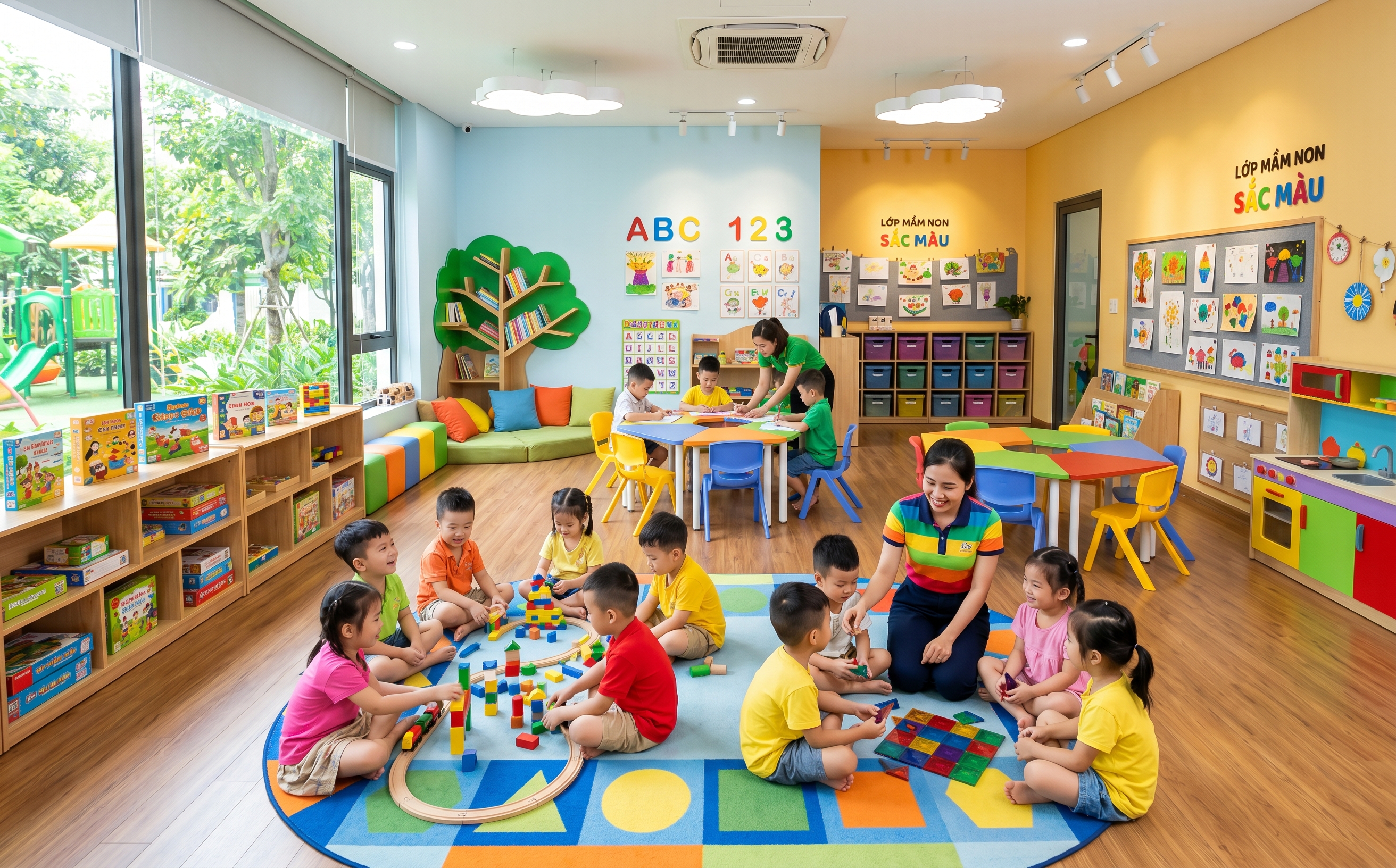
What are preschool student tables and chairs?
Preschool student tables and chairs are a line of furniture designed specifically for children in nursery, kindergarten, and pre-primary school ages. Unlike tables and chairs for older students, preschool furniture is usually lower in height, more compact in design, brighter in color, and places greater emphasis on safety during use.
Easily noticeable features of preschool student tables and chairs are their child-appropriate height, easy-to-clean table surfaces, chairs of suitable weight, safely finished edges, and colors that feel friendly. Some table and chair sets are also designed flexibly so teachers can easily arrange them into groups, learning corners, or according to daily activities.
In a preschool environment, tables and chairs are not just for learning letters or doing simple exercises. They are also places where children draw, color, have snacks, play educational games, read books, do group work, and participate in skill-building activities. Therefore, tables and chairs need to be safe, durable, and easy to use to meet children's diverse learning and play needs.
Standard dimensions of preschool student tables and chairs
Size is an important factor when choosing preschool student tables and chairs. Children at this age are growing rapidly in height, build, and motor skills, so tables and chairs should be selected based on the child's actual age and height rather than just by design.
According to reference information on kindergarten student furniture standards, chair height typically ranges from 26cm, 28cm, or 30cm; corresponding table height is around 48cm, 50cm, or 52cm. Tables and chairs should also be separate pieces, not attached together, and chairs should have backrests to support children's sitting posture.
When choosing table and chair sizes, schools should note the following:
-
Children should be able to sit with both feet touching or nearly touching the floor, knees not cramped.
-
The table surface should be at a comfortable height for children to rest their arms when drawing, writing, or handling learning materials.
-
The distance between the table and chair should be wide enough for children to get in and out easily, without being stuck or having to bend over excessively.
-
Do not choose a table that is too high as children may have to raise their shoulders, lift their arms, or bend incorrectly.
-
Do not choose a chair that is too low as children may experience back fatigue, have difficulty seeing the table surface, and lose focus quickly.
For preschools with multiple age groups, prioritize table and chair lines with various sizes or flexible solutions for each area. For example, the nursery area needs low, lightweight, easily movable furniture; the older kindergarten area can use higher tables with wider surfaces for activities like coloring, practicing writing, reading, or group learning.
See more:
-
Preschool student tables: choosing the right safe and durable standard
-
Preschool student chairs -- Bright colors, safe for children
Criteria for choosing safe preschool student tables and chairs
Safe, child-friendly materials
Material is the top priority criterion when choosing preschool student tables and chairs. Since children come into direct contact with the furniture daily, products must be made from safe materials, free of unpleasant odors, containing no toxic components, and suitable for an educational environment.
Common materials include virgin plastic, natural wood, surface-coated engineered wood, powder-coated metal, or combinations of plastic, wood, and steel frames. For plastic furniture, schools should prioritize types with good durability, smooth surfaces, easy cleaning, and no sharp edges. For wooden furniture, pay attention to the surface coating, smoothness, scratch resistance, and safety of the paint finish. For furniture with metal frames, the frame should be powder-coated to minimize rust and increase durability over long-term use.
Rounded-edge design to minimize injury
Preschool children are often active, prone to running, jumping, bumping, or constantly changing positions. Therefore, furniture needs a safe design that minimizes sharp details or dangerous edges. Table edges, chair sides, table legs, chair legs, and connection points must be carefully finished to reduce the risk of scratches, impacts, or pinched hands.
Table and chair models with rounded edges, smooth surfaces, and sturdy structures are more suitable for preschool environments. Additionally, chairs should have good stability, not easily tipping over when children sit off-center, turn around, or stand up and sit down frequently. For models with wheels or folding tables, schools should carefully check the locking mechanism, balance, and safe operation before putting them into use.
Bright colors to stimulate creativity
The height of tables and chairs must be chosen according to age group and the actual height of the children. A suitable set helps children sit with a straight back, rest arms comfortably on the table surface, easily observe learning activities, and avoid leaning too close to the table.
For preschool classrooms, one size of table and chair should not be used for all age groups. Children aged 2-3, 4-5, and 5-6 have clear differences in height, motor skills, and usage needs. Therefore, schools should divide usage areas by age group or choose product lines with diverse sizes to ensure suitability.
Durability and load capacity
Preschool furniture is typically used continuously every day and withstands impact from many different activities. Children may pull chairs, move tables, place toys on the table surface, draw, do crafts, or accidentally bump into them during use. Therefore, products need good durability, sturdy structure, and appropriate load capacity.
Furthermore, furniture should be easy to clean. The table surface should resist staining and be easy to wipe clean of color marks, dust, light food, or glue. Chairs should have surfaces that are easy to clean, do not absorb too much dirt, and do not develop odors after prolonged use. This is an important factor that helps schools save cleaning and maintenance time and maintain a clean, attractive classroom image.
Top 4 colorful and safe preschool student table and chair sets
Preschool student tables and chairs today not only need to meet basic sitting needs but also suit various other activities such as drawing, coloring, reading, crafting, group learning, or guided play. Therefore, when choosing furniture for preschool classrooms, schools should prioritize models with safe design, friendly colors, easy cleaning, and flexible arrangement for daily activities.
Depending on classroom size, children's age, and spatial organization style, schools can refer to the popular furniture groups below.
Multi-color virgin plastic table and chair set
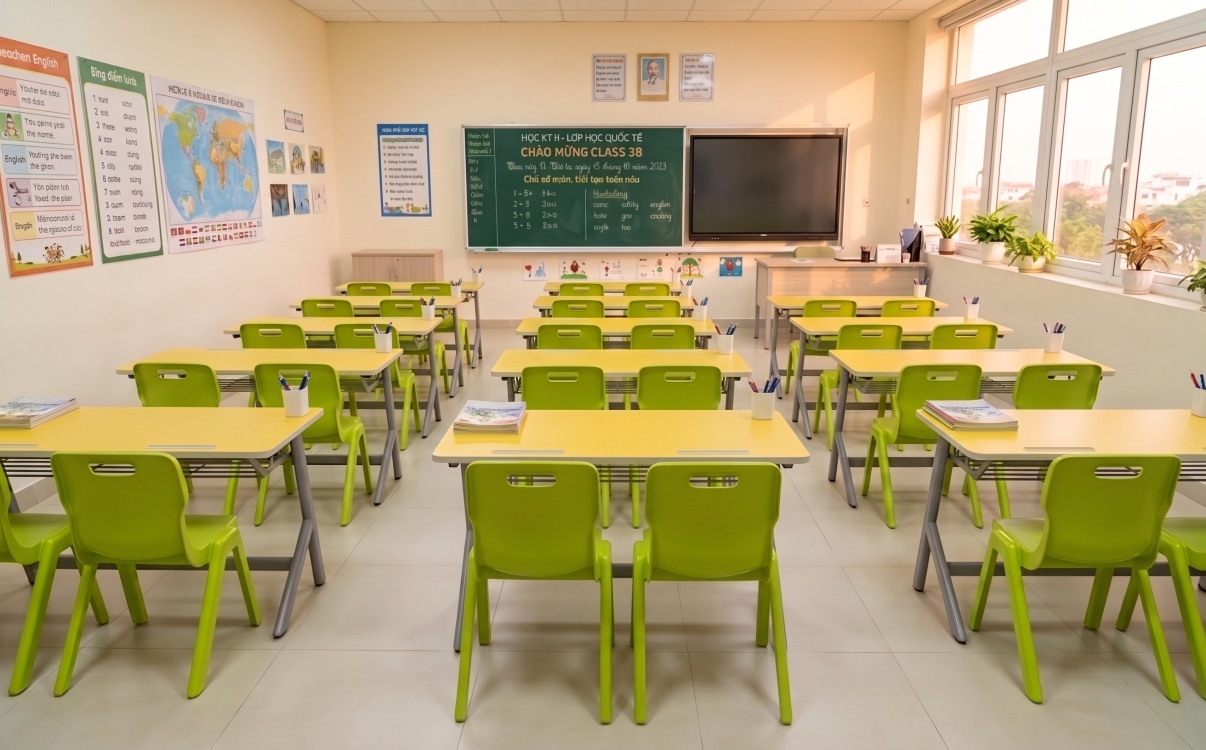
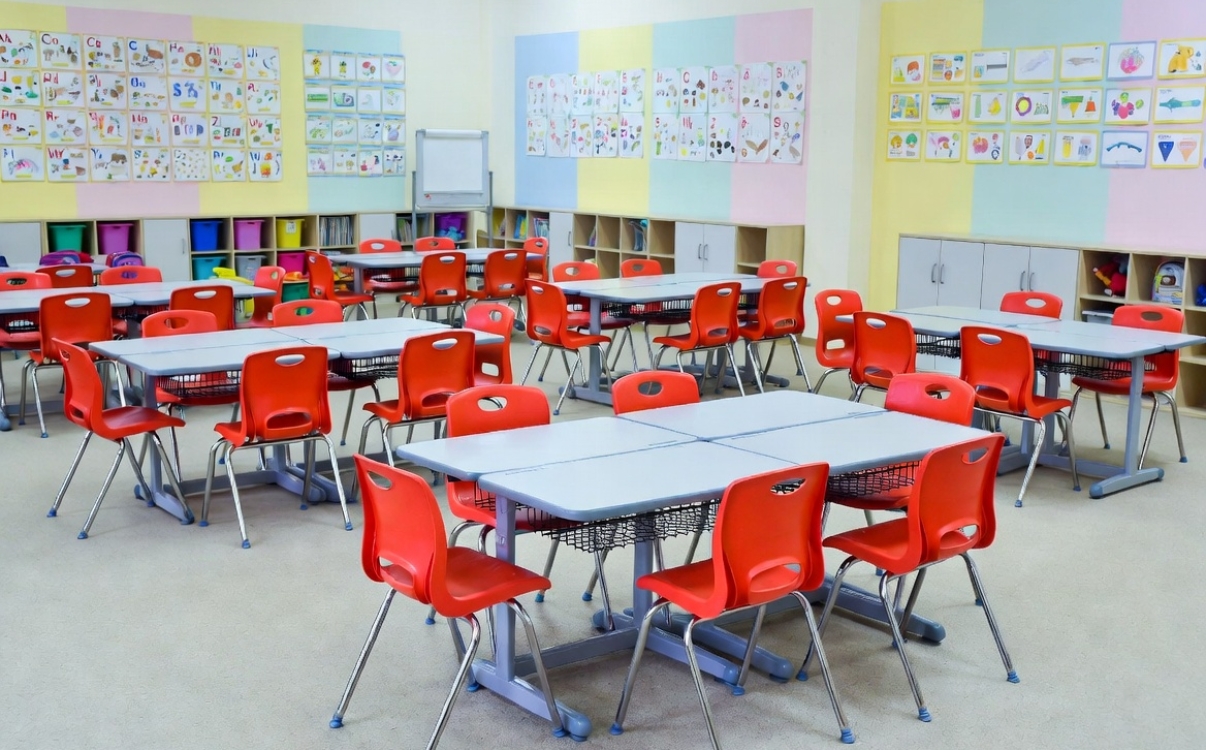
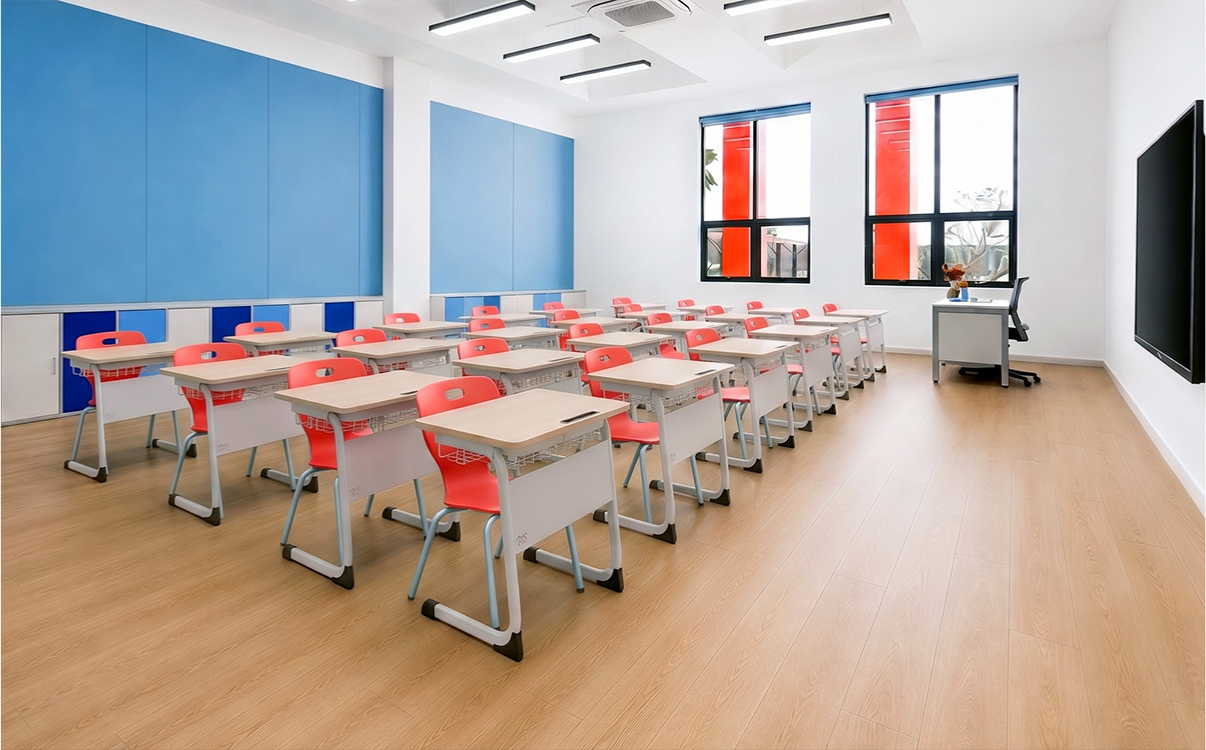
Multi-color virgin plastic tables and chairs are suitable for preschool classrooms needing a lively, lightweight space that is easy to rearrange. The advantage of this product group is that they are usually lighter than wooden or metal furniture, helping teachers easily move and rearrange the classroom for different activities like group learning, reading, building blocks, or group gatherings.
For preschoolers, plastic materials need a smooth surface, easy cleaning, minimal staining, and no sharp edges that could cause injury upon impact. Bright colors like blue, yellow, red, orange, or pastel shades also make the classroom more approachable, create a cheerful feeling, and stimulate children's curiosity and creativity. Additionally, the chair design should be compact, easy to grip, and stackable to save space after class.
Powder-coated steel frame with plastic surface table and chair set
Tables and chairs with powder-coated steel frames and plastic surfaces suit preschools needing high durability, good load capacity, and long-term stability. The steel frame makes the furniture sturdier, minimizing wobbling when children sit to study, stand up, move around, or participate in class activities. The powder coating increases surface durability, minimizes rust, and suits high-frequency usage environments.
The plastic seat, backrest, or table surface makes the product easier to clean, especially in preschool classrooms where furniture often contacts crayons, markers, glue, light snacks, or dirt. For younger children, the plastic surface also needs a smooth finish, no sharp edges, and no discomfort upon direct contact. This furniture line is suitable for classrooms, common activity rooms, talent learning areas, or spaces needing durable, low-maintenance products that optimize long-term costs.
Flexible modular table and chair set
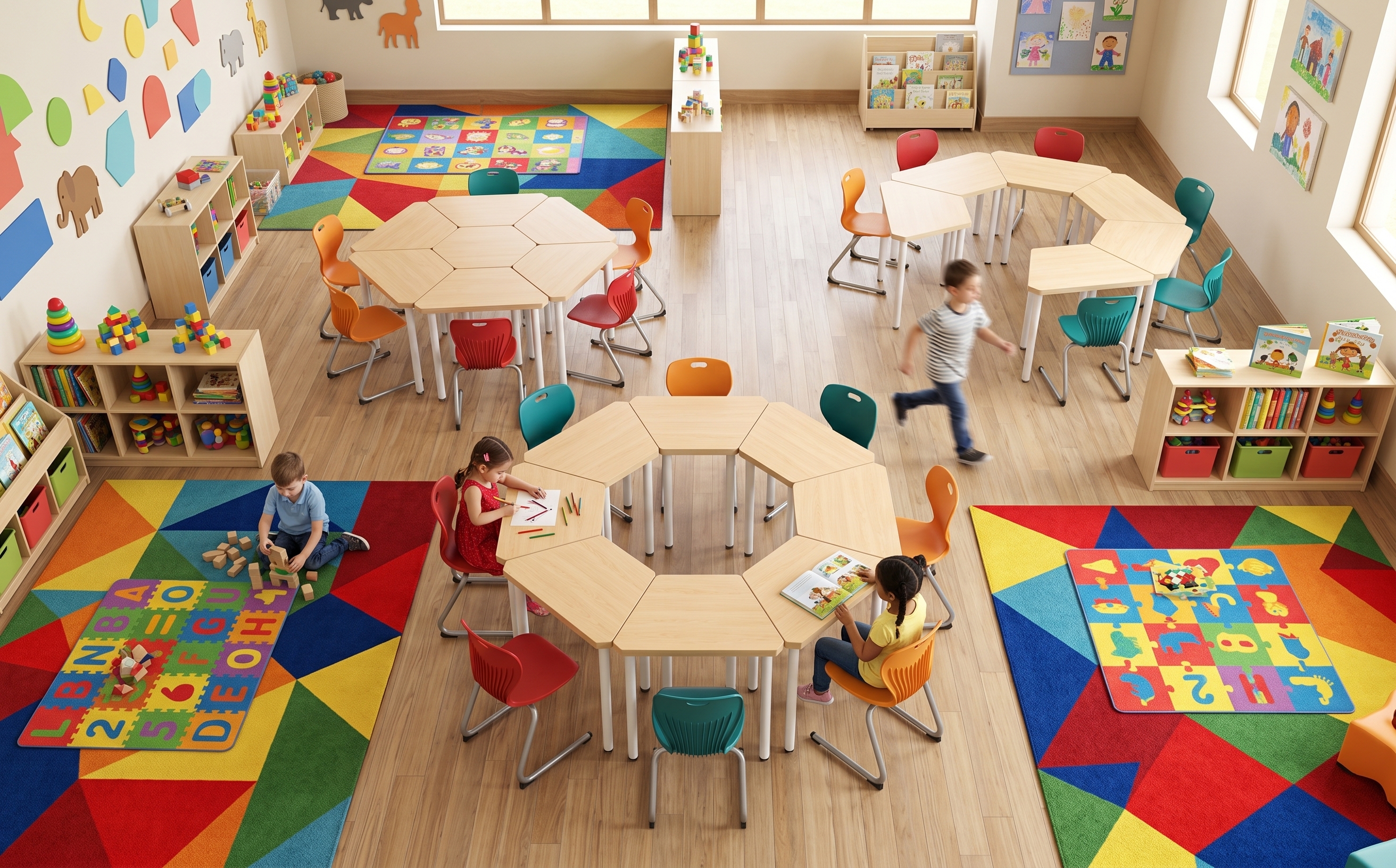
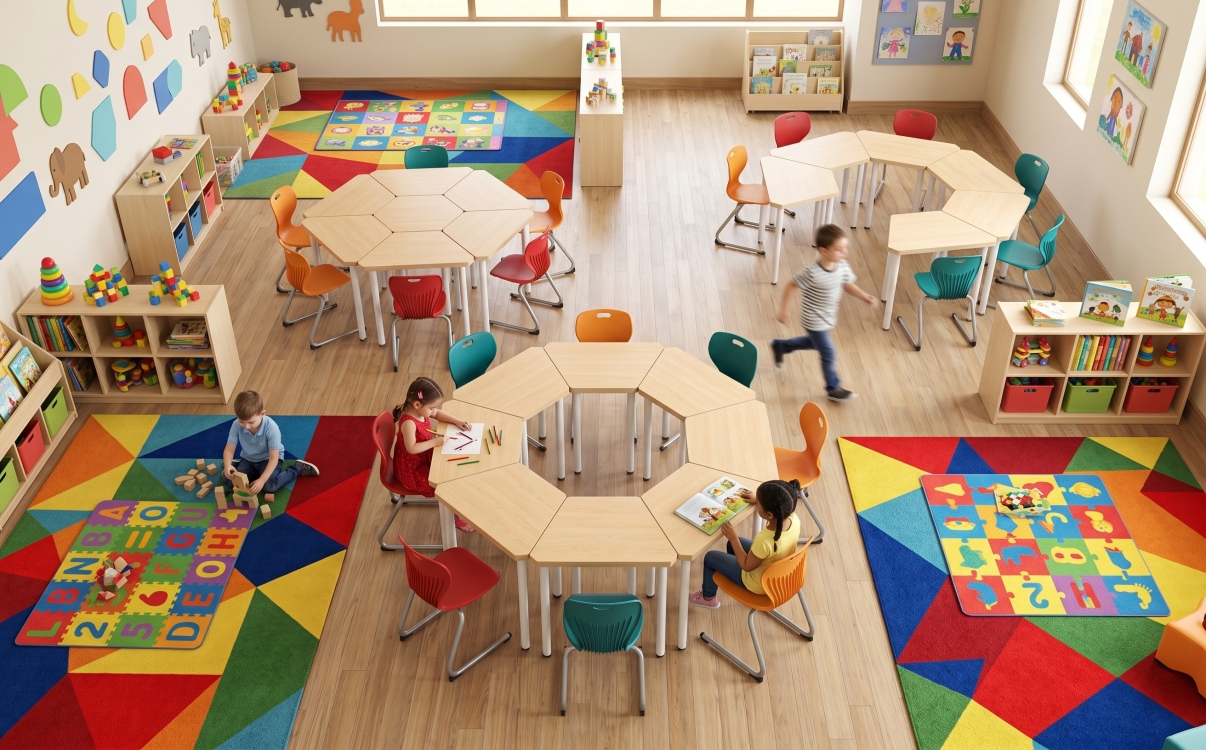
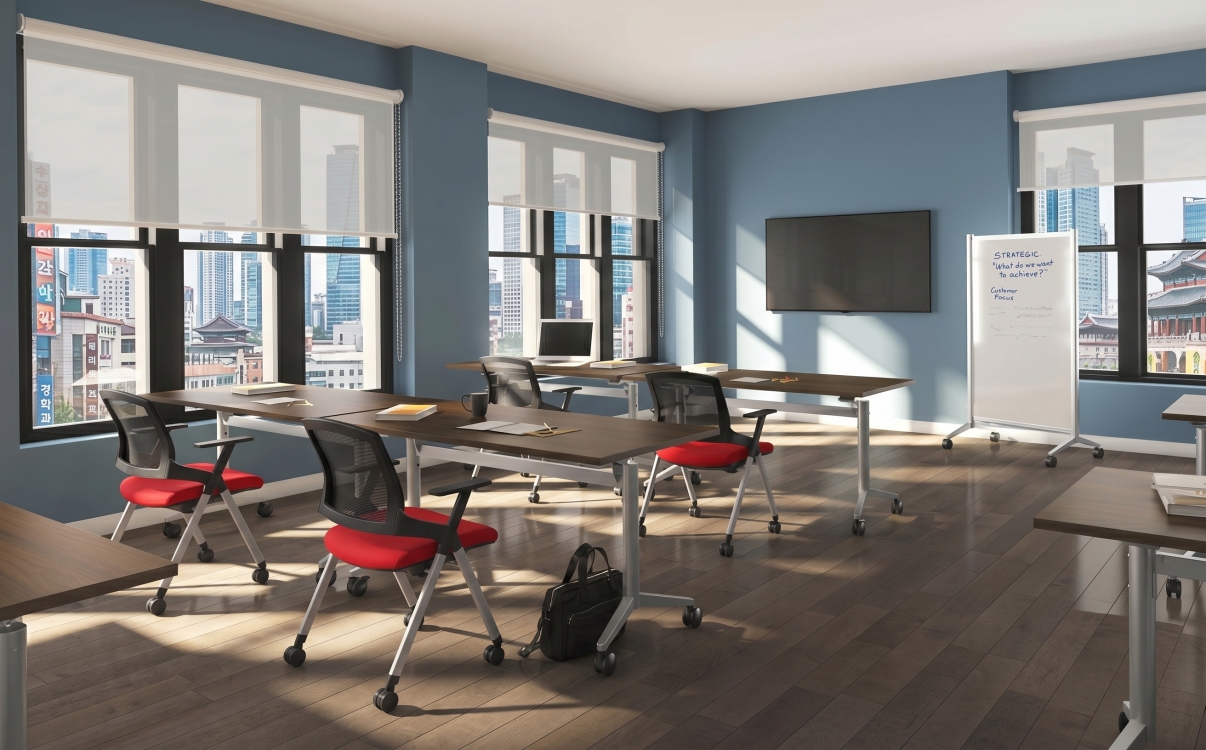
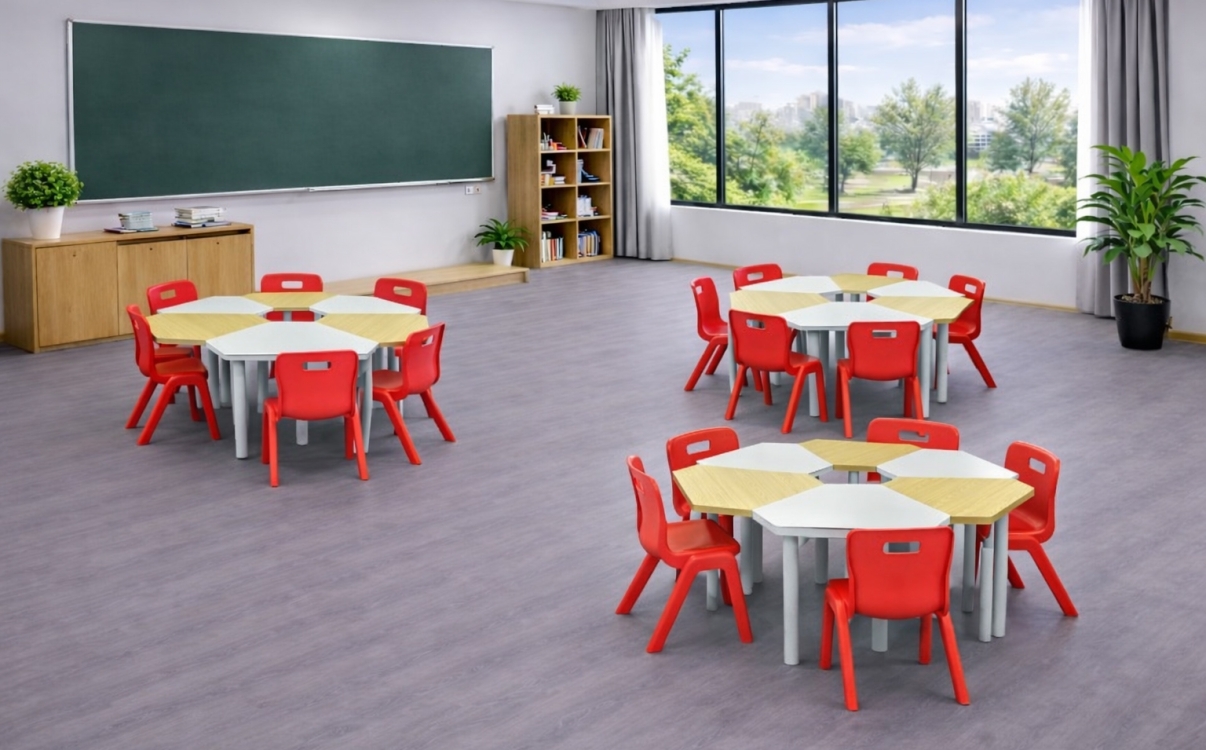
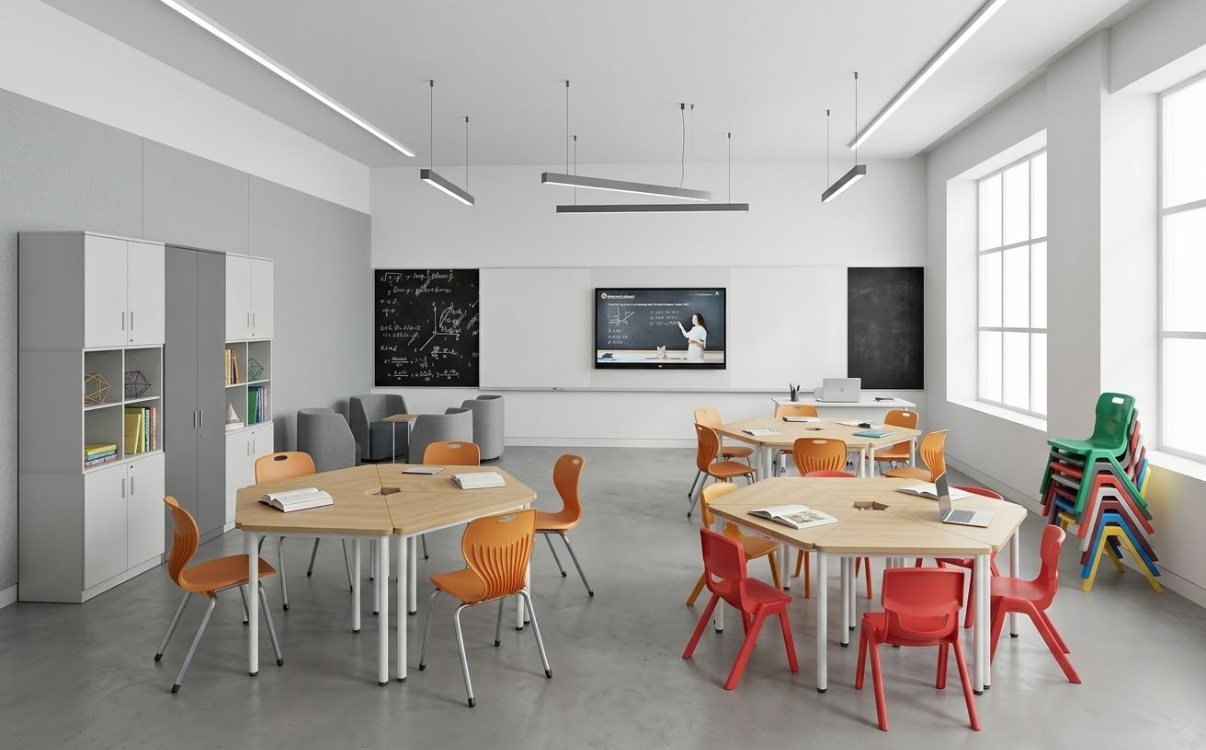
Modular tables and chairs are a very suitable choice for modern preschool classroom models. Unlike fixed row arrangements, modular tables can be combined into small groups, circular clusters, semicircular clusters, or many other configurations depending on the activity. This helps teachers easily change the classroom space, from individual to group activities, from creative time to story time, crafts, or group gatherings.
A major advantage of modular furniture is increasing interaction among children. When sitting in clusters, children can easily observe friends, communicate with teachers, and participate in group activities more naturally. The modular design also makes the classroom more dynamic, less rigid, and suitable for child-centered education methods. When choosing, schools should prioritize models with safe rounded edges, easy-to-clean surfaces, sturdy legs, and colors harmonizing with the overall classroom.
Ergonomic table and chair set
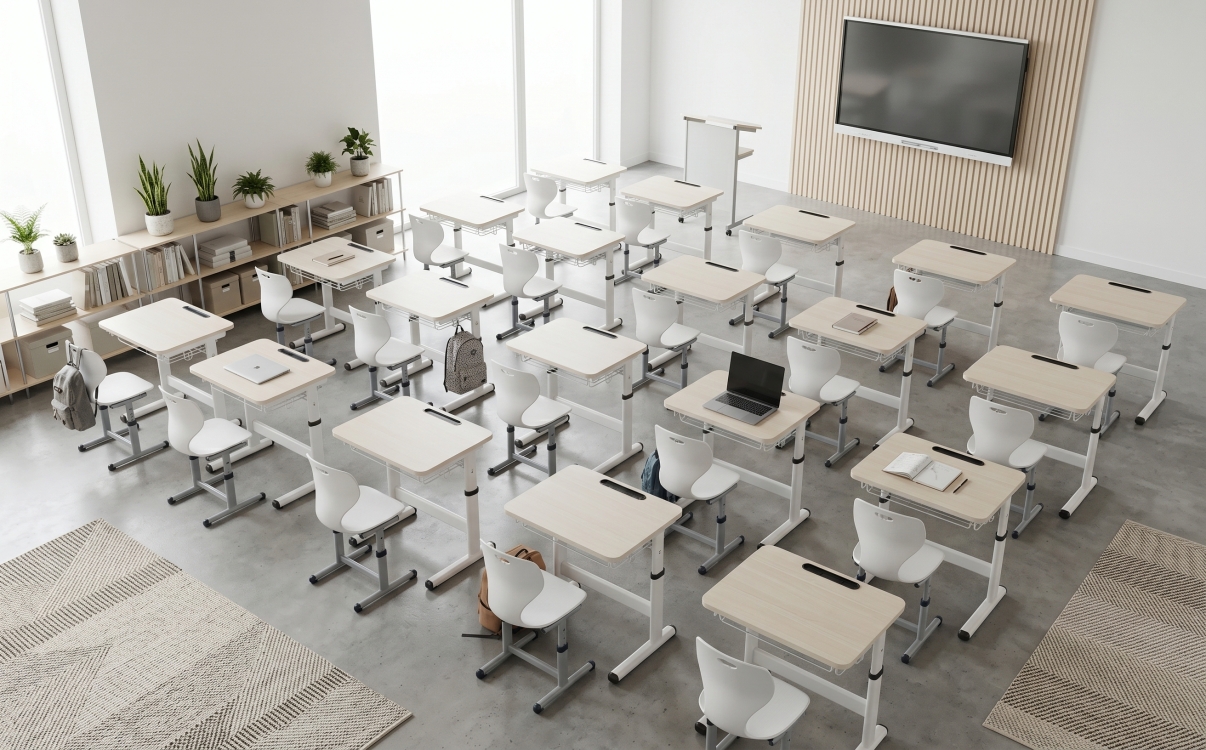
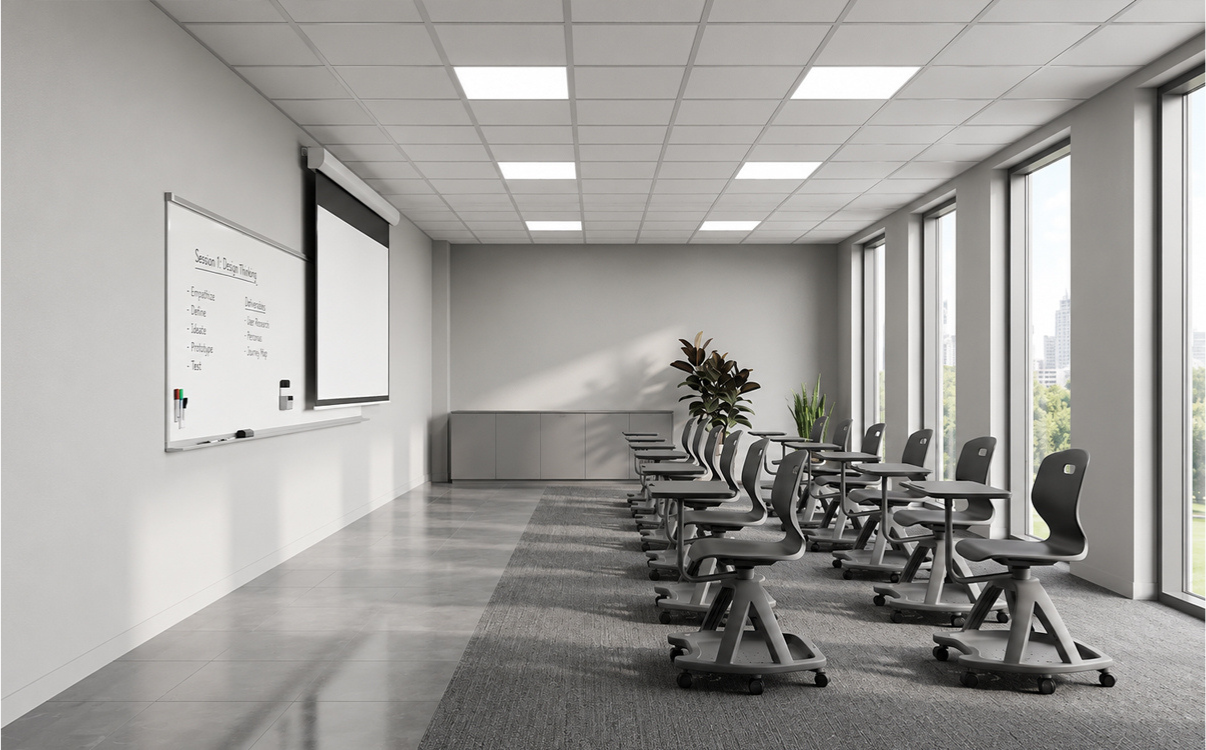
Ergonomic tables and chairs are a product group focused on sitting posture, comfort, and body support during learning. For preschoolers, ergonomics doesn't necessarily mean complex mechanisms; rather, it primarily involves appropriate dimensions, a properly sized seat, supportive backrest, stable structure, and a design that helps children sit more comfortably during daily learning activities.
A suitable ergonomic chair for children should have a slightly curved seat, a backrest providing basic support, height compatible with the table, and not cause constraint when sitting for long periods. The design also needs to be safe, minimizing pinch points, sharp edges, or details prone to impact. When tables and chairs have appropriate dimensions, children can easily place their feet and arms and maintain a natural sitting posture, thereby increasing focus and learning enthusiasm.
Reference preschool student table and chair models at RPB Education & Public
Hexa study table
The Hexa study table is a standout model for flexible modular tables. It features a hexagonal table surface, optimizing space and encouraging classroom interaction. The hexagonal structure allows the table to be arranged in many ways, suitable for group activities, discussions, or educational environments needing creativity. The table surface has rounded corners for increased safety and user-friendliness.
Regarding materials, the Hexa table uses an 18mm thick Melamine-coated MFC table surface, which resists water absorption, prevents scratches, and is easy to clean. The table leg frame is made of powder-coated steel, offering good load capacity, resistance to wobbling, and suitability for high-frequency use. The product also has many color options for the table surface and legs, helping schools easily coordinate with spaces like classrooms, libraries, or common activity areas.
See product: Hexa Table
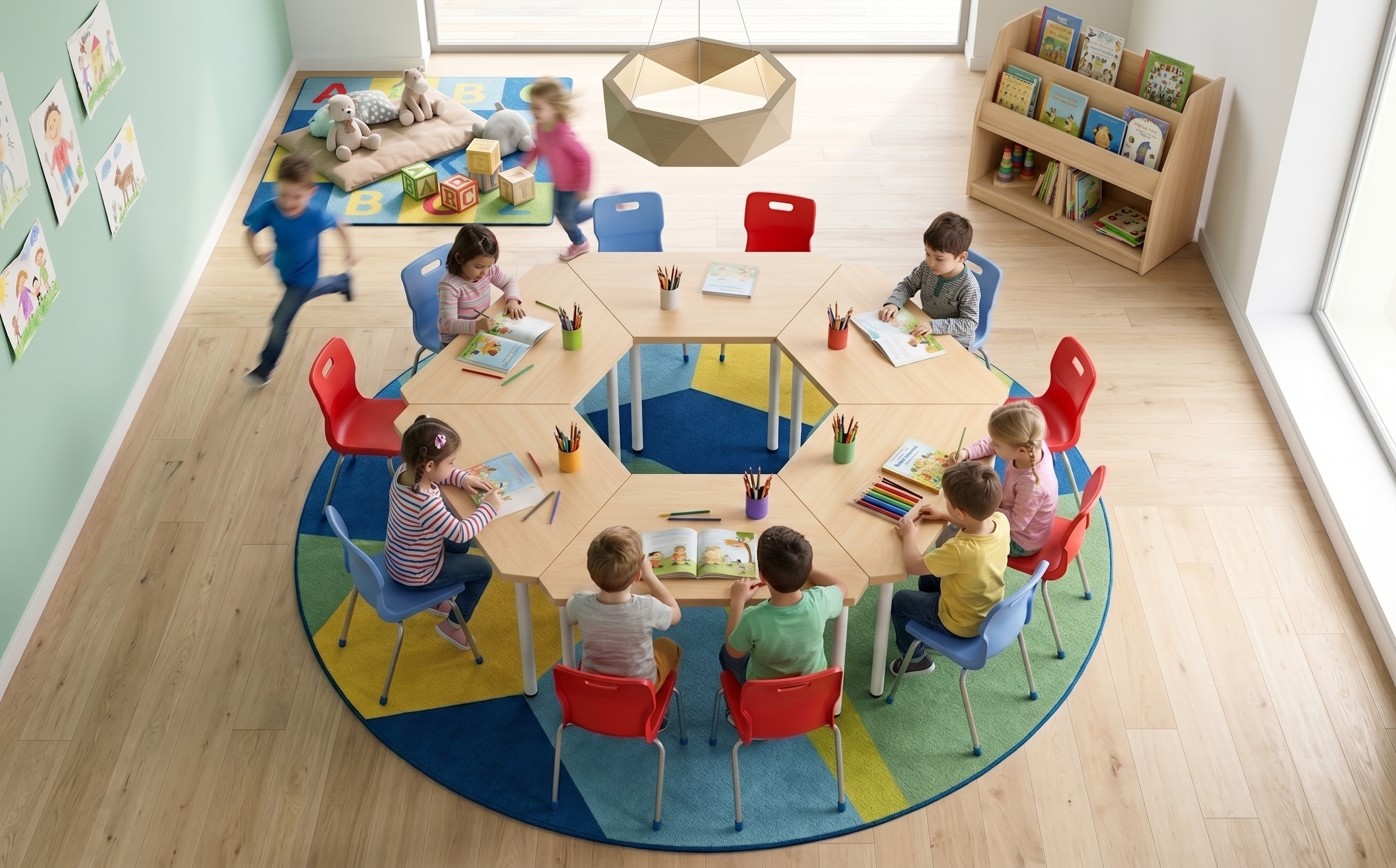
Besides Hexa, the Hico preschool study table is also a suitable suggestion for group learning spaces. This table line has a compact, lightweight design, is easy to move, and can be flexibly arranged for various group activities in kindergarten or primary classes. The table's open design creates a friendly feeling, supporting children to communicate, cooperate, and learn from each other.
Hico table
The Hico table uses an 18mm thick Melamine-coated MFC table surface, which is scratch-resistant, limits water absorption, and is easy to clean. The powder-coated steel leg frame increases sturdiness, prevents rust, and handles loads well. The product also allows color selection for the table surface from the MFC color palette, ranging from bright, cheerful tones to neutral ones, making the classroom more lively and inspiring children's learning.
See product: Hico Table
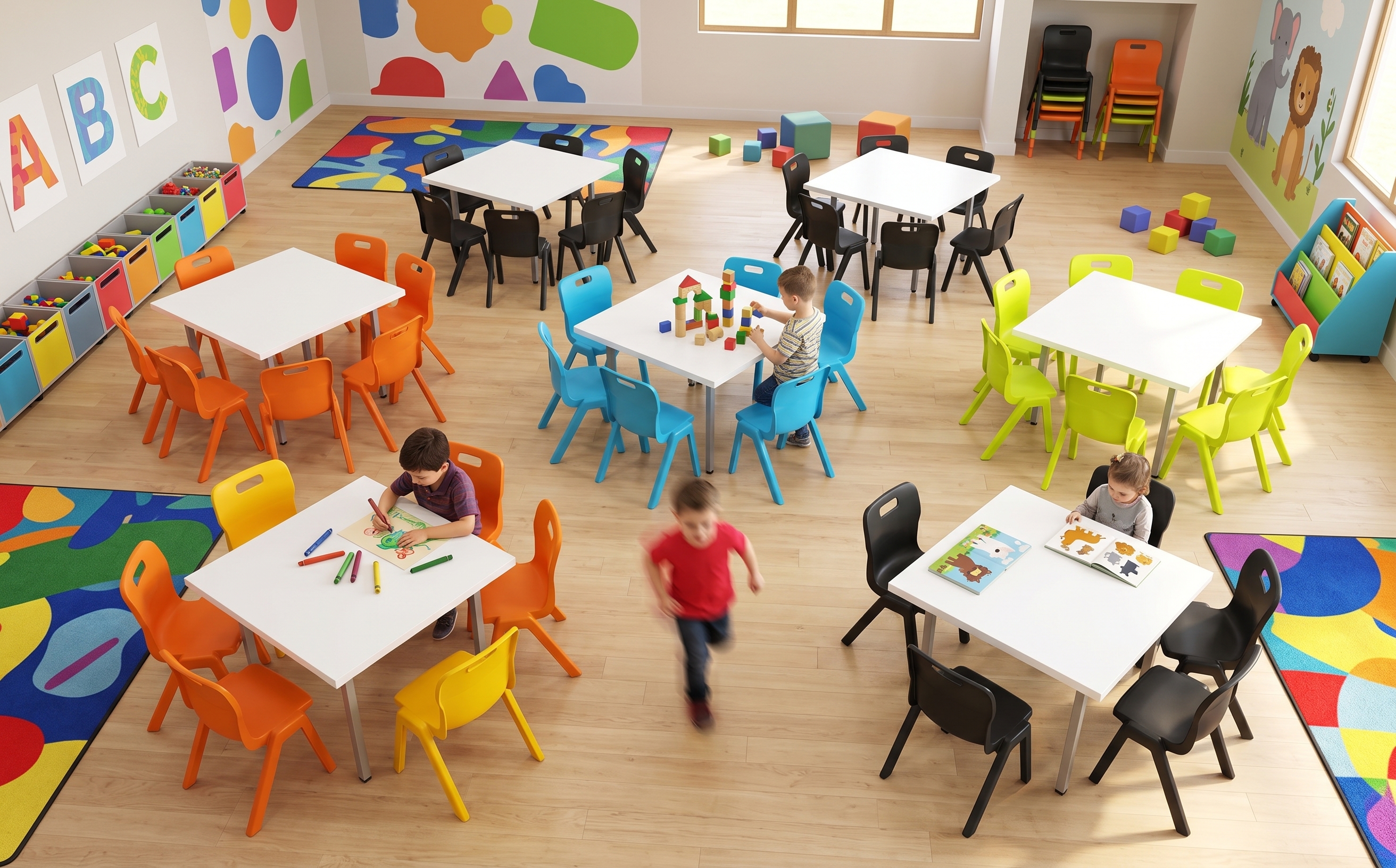
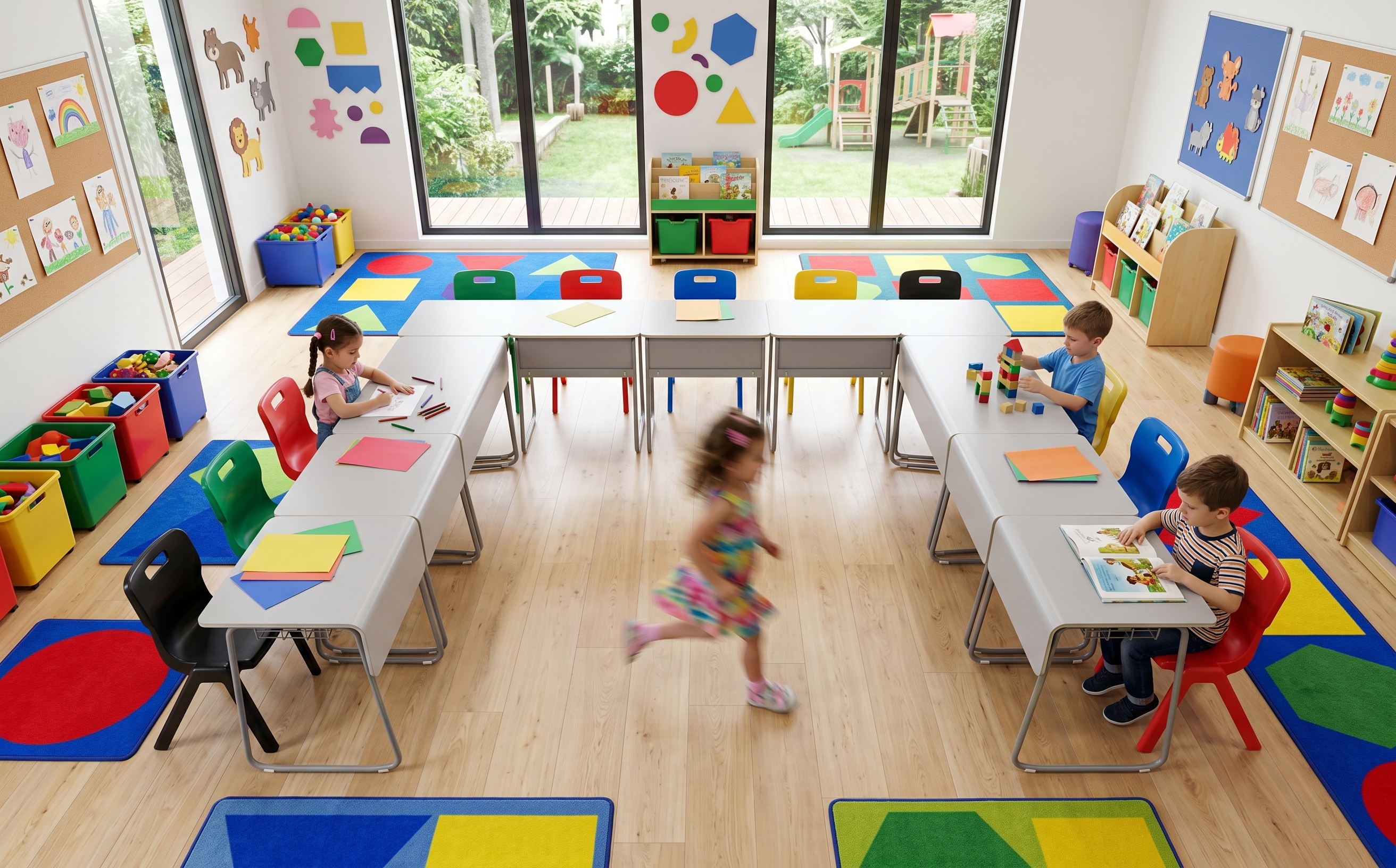
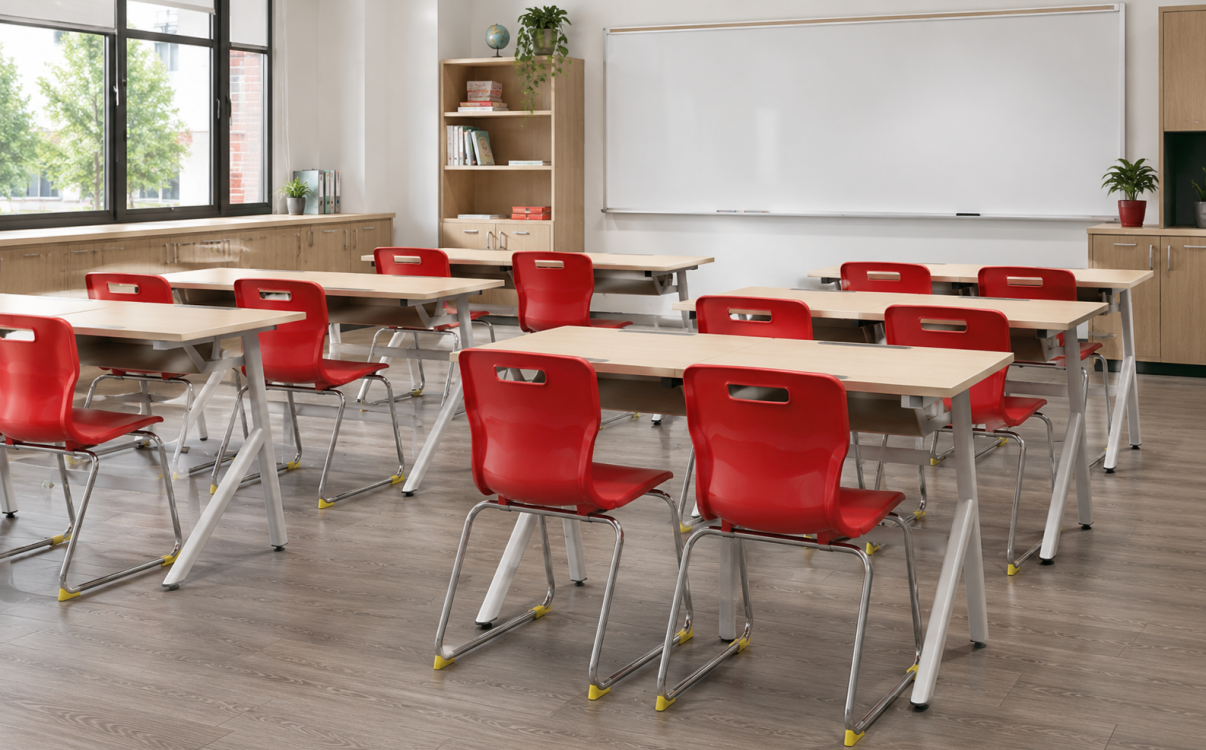
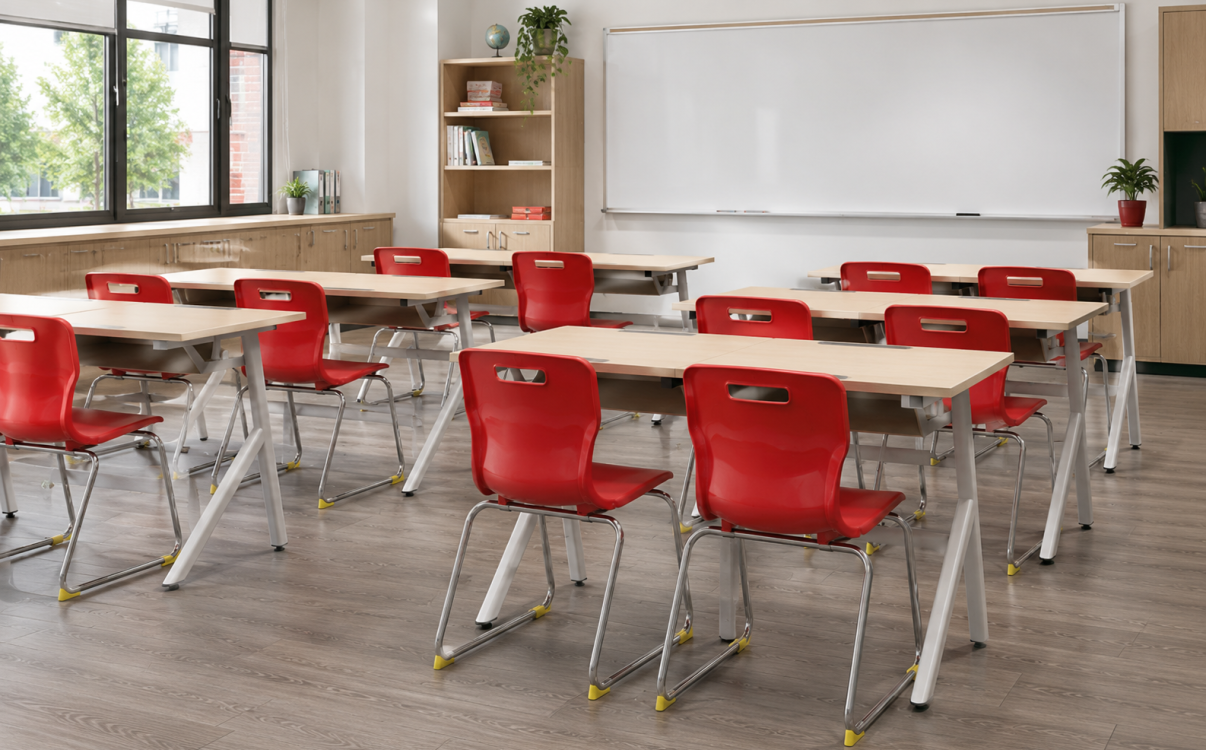
At RPB Education & Public, the Titan virgin plastic chair is a reference model for this product group. The chair is made of solid virgin plastic, easy to clean, stackable, and suitable for modern classroom environments needing flexibility and space saving. The product has an armless design, convenient handle, can be stacked up to 15 chairs high, and comes in many sizes from size 01 to size 06, suitable for various age groups.
Besides color and lightness, the Titan chair is also oriented towards educational environment standards. The product meets EN1729 standards for durability, stability, and ergonomics for educational furniture; the backrest and seat are made of high-grade plastic, easy to clean, legs are sturdy, and it features an anti-tilt design to increase safety during use.
See product: Titan Chair
Moto 02 chair
At RPB Education & Public, the Moto 02 plastic-back chair is a suitable suggestion for the group of powder-coated steel frame chairs with plastic surfaces. The product has a minimalist, armless design, saving space and making it easy to arrange in many spaces such as classrooms, waiting areas, or dining areas. The backrest and seat cushion are made of durable, easy-to-clean plastic; the C-channel steel frame is powder-coated for increased sturdiness, rust prevention, and good load capacity.
The Moto 02 chair also comes in many modern colors, easy to coordinate with different classroom styles, from youthful spaces to professional learning environments. For preschool classrooms needing easy-to-clean, easy-to-arrange chairs capable of long-term use, this model can be combined with low study tables, group tables, or modular tables to create a suitable table and chair set for children.
See product: Moto Chair
Benefits of using quality preschool tables and chairs
Investing in quality preschool furniture not only completes the classroom space but also directly affects children's safety, sitting posture, concentration ability, and daily learning experience. At preschool age, children often participate in various activities such as coloring, drawing, reading, building blocks, doing crafts, or group learning. Therefore, tables and chairs need to be chosen appropriately to both support learning activities and ensure comfort throughout use.
Protecting the spine and sitting posture
One of the most important benefits of quality preschool tables and chairs is helping children develop correct sitting posture from the early years. When tables and chairs have the right height, children can comfortably rest their arms on the table surface, lean back naturally, have feet touching or nearly touching the floor, and not have to bend over excessively while studying.
Conversely, if the table is too high or chair too low, children tend to raise their shoulders, lean too close to the table, or sit off-center for extended periods. These habits can cause back and neck fatigue, reduce comfort, and affect participation in class activities. Therefore, schools should prioritize table and chair models with sizes suitable for each age group, stable structure, and a backrest that supports basic sitting posture.
For preschool environments, furniture does not need overly complex designs but must ensure children sit comfortably, move safely, and use furniture appropriate for their body type. This is an important foundation for children to become accustomed to learning routines and maintain good posture during daily activities.
Increasing concentration ability
Suitable furniture also helps children concentrate better during learning and guided play. When children sit comfortably, without constraint, and do not have to constantly change posture due to fatigue or discomfort, they can pay better attention to activities like coloring, reading, building puzzles, listening to stories, or doing group work with friends.
A table and chair set with a properly sized surface, reasonable usable area, and stable seating helps children manipulate things more easily. Children have enough space to place learning materials, crayons, drawing paper, books, or educational toys without feeling cramped. This helps teachers organize activities easily and allows children to participate naturally and more proactively.
Additionally, furniture with harmonious colors, friendly design, and suitability for the classroom space also helps reduce stress and creates a happy psychological state for children. When the learning space is scientifically arranged, children can more easily form habits of sitting to study, interacting, and completing activities positively.
Creating a lively learning environment
At preschool level, colors and spatial arrangement greatly impact children's emotions and interest. Table and chair models with bright colors, friendly designs, and flexible layouts make the classroom more lively and approachable. This is a key factor in creating a positive learning environment where children feel happy coming to class and are ready to participate in activities with teachers.
Quality preschool furniture also helps schools easily organize various learning models. For example, modular tables can be combined into small groups for children to do group work, arranged into clusters for creative activities, or set up in learning corners such as a reading corner, art corner, skills corner, and play corner. This flexibility prevents the classroom space from being monotonous while supporting child-centered education methods.
A lively learning environment is not just about using many colors but also requires harmony between tables, chairs, shelves, storage areas, and functional zones in the classroom. When furniture is chosen cohesively, the classroom has better aesthetics, is easier to manage, and creates a professional impression for the school.
Saving long-term costs
Investing in quality preschool furniture from the start can help schools save money over long-term use. Products with durable materials, sturdy structure, easy-to-clean surfaces, and good load capacity will minimize damage, warping, peeling, or the need for frequent replacement.
In preschool environments, furniture is used with high frequency and withstands many impacts from daily children's activities. Children may pull chairs, move tables, drop items, draw, glue paper, or spill light snacks on the table surface. Therefore, products with easy-to-clean surfaces, minimal staining, and durable materials will help schools reduce cleaning, maintenance, and repair time.
Additionally, furniture with flexible design, easy arrangement, and suitability for multiple activities helps schools optimize usage efficiency. Instead of having to invest in many different types of furniture for each area, schools can choose product models that meet multiple needs such as group learning, reading, crafts, group activities, or experiential activities. This is a practical investment, optimizing budget while ensuring quality learning space for children.
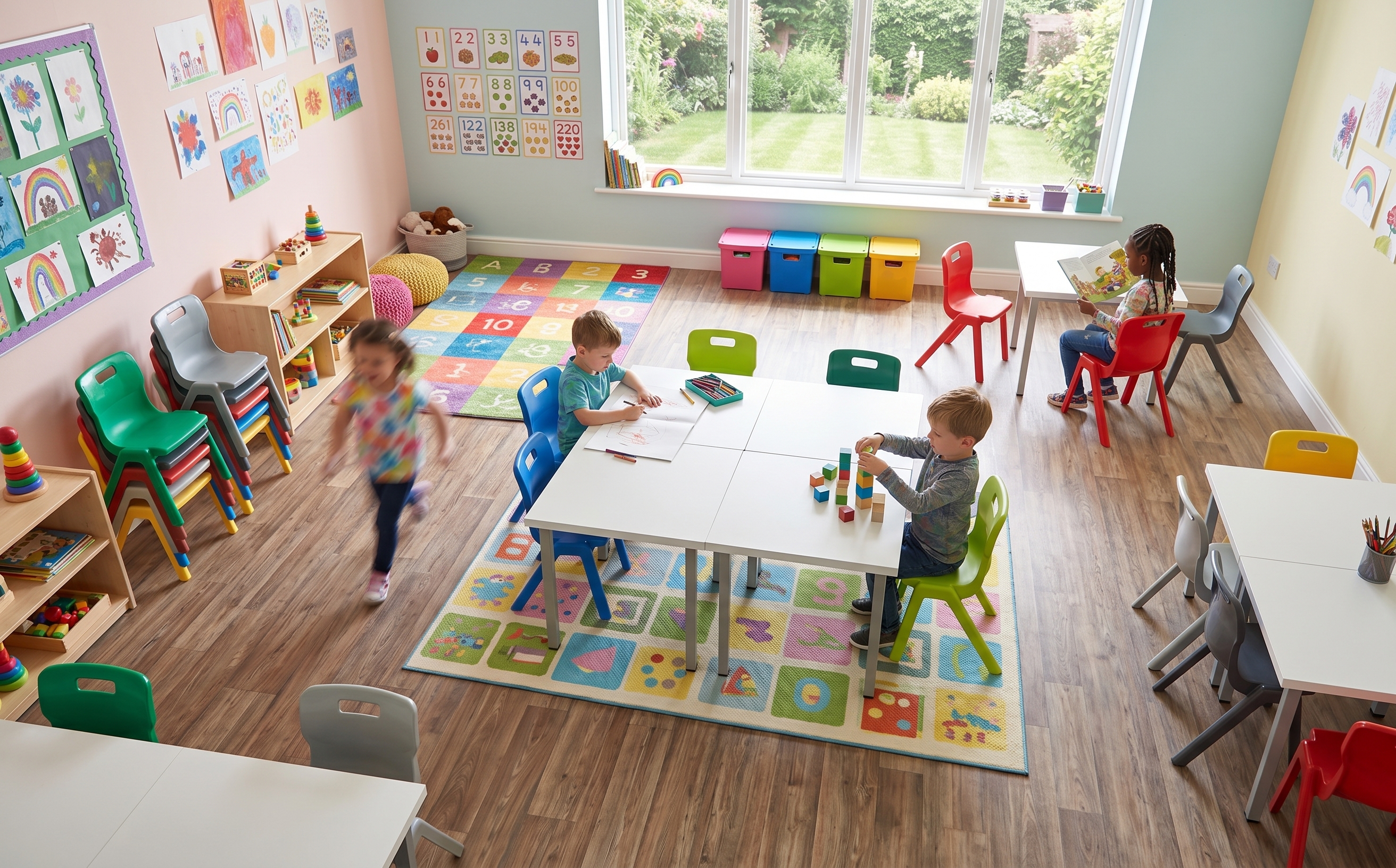
See more: 6 Safe and creative preschool classroom design models
Experience in choosing suitable preschool tables and chairs
To choose suitable preschool furniture, schools should not rely solely on design or price. A good set needs to simultaneously meet many criteria such as appropriate size, safe materials, friendly design, high durability, easy cleaning, and suitability for long-term use. Below are some important tips to consider when selecting preschool student tables and chairs.
Choose according to children's age and height
Children's age and height are the first factors to consider when choosing preschool furniture. Children of different age groups have clear differences in height, reach, motor skills, and usage needs. Therefore, schools should not use one size of table and chair for the entire preschool block.
For younger children, furniture should be low in height, moderate in weight, with chairs easy to sit on and stand up from. For older kindergarten children, the table surface can be wider to serve activities like practicing writing, drawing, reading, or group learning. When choosing, ensure children can sit comfortably, place arms naturally on the table surface, keep back straight, and not have legs dangling too high above the floor.
Besides size, schools should also consider furniture arrangement in each space. Small classrooms should prioritize compact, lightweight models that are easy to move or stack. Open-model classrooms can choose modular tables for easy layout changes per activity.
Prioritize products with safety certification
Safety is a particularly important criterion when choosing furniture for preschoolers. Products should be made from safe materials, free of unpleasant odors, containing no toxic components, and suitable for educational environments. Details like table edges, chair edges, table legs, chair legs, and connection points must be carefully finished to minimize risk of impact or scratches.
Schools should prioritize products with clear information about materials, production standards, or certifications related to durability, stability, and safety during use. For plastic furniture, choose good quality plastic with a smooth, easy-to-clean surface. For wooden furniture, pay attention to the surface coating, smoothness, and scratch resistance. For steel frame furniture, prioritize powder-coated frames to increase durability and minimize rust during use.
Choosing products with clear standards not only ensures children's safety but also gives schools peace of mind during long-term operation.
Choose a reputable supplier
A reputable supplier helps schools select products more suitable for actual needs, classroom space, and investment budget. Instead of buying individual products, schools should prioritize suppliers capable of providing total solutions, from student tables and chairs, storage shelves, functional zones, to learning space layout.
A professional supplier needs clear product information, accurate needs assessment, proposals suitable for each age group, and support during implementation. For school projects, consistency is also very important. When tables, chairs, shelves, and other furniture items are chosen according to the same orientation, the space has better aesthetics, is easier to operate, and easier to manage.
Additionally, schools should consider warranty policies, ability to supply large quantities, delivery schedules, and after-sales support. These factors help the investment process go smoothly, especially for schools renovating, expanding, or building new preschool spaces.
Balance the budget
Budget is an important factor but should not be the only criterion when choosing preschool furniture. Cheap, low-quality products may quickly break, be hard to clean, lack safety, or not suit long-term use. This forces schools to spend extra on repairs and replacements, affecting children's learning experience.
Instead of choosing solely based on initial price, schools should consider total cost of ownership over the long term. A product with good durability, easy maintenance, safety, and suitability for multiple activities will yield a higher return on investment. For projects with limited budgets, prioritize investing first in high-frequency areas like main classrooms, reading areas, common activity areas, or skills rooms.
Schools can also work with suppliers to get product options tailored to different budget levels. This ensures reasonable investment costs while maintaining important criteria like safety, color, durability, and cohesion for the entire space.
Conclusion
Preschool student tables and chairs play an important role in building a safe, friendly, and effective learning environment for children. This is not just furniture for sitting and studying, but also a factor that helps children develop correct posture, increase concentration, participate in group activities, and develop creativity in their early years.
When choosing preschool furniture, schools need to pay special attention to criteria such as safety, color, and durability. Products must have dimensions suitable for age, safe materials, rounded-edge design, easy-to-clean surfaces, lively colors, and sturdy structure to meet the demands of daily high-frequency use in educational environments.
With experience providing furniture solutions for schools and public spaces, RPB Education & Public offers preschool table and chair models suitable for various spaces, usage needs, and investment budgets. From study tables and chairs, modular tables, virgin plastic chairs, to comprehensive solutions for classrooms, libraries, play areas, and common activity areas, RPB Education & Public partners with schools in building safe, durable, and inspiring learning spaces for children.
Contact RPB Education & Public now via hotline: 19000324 for advice on the most suitable preschool furniture solution for your space and budget.
Related News
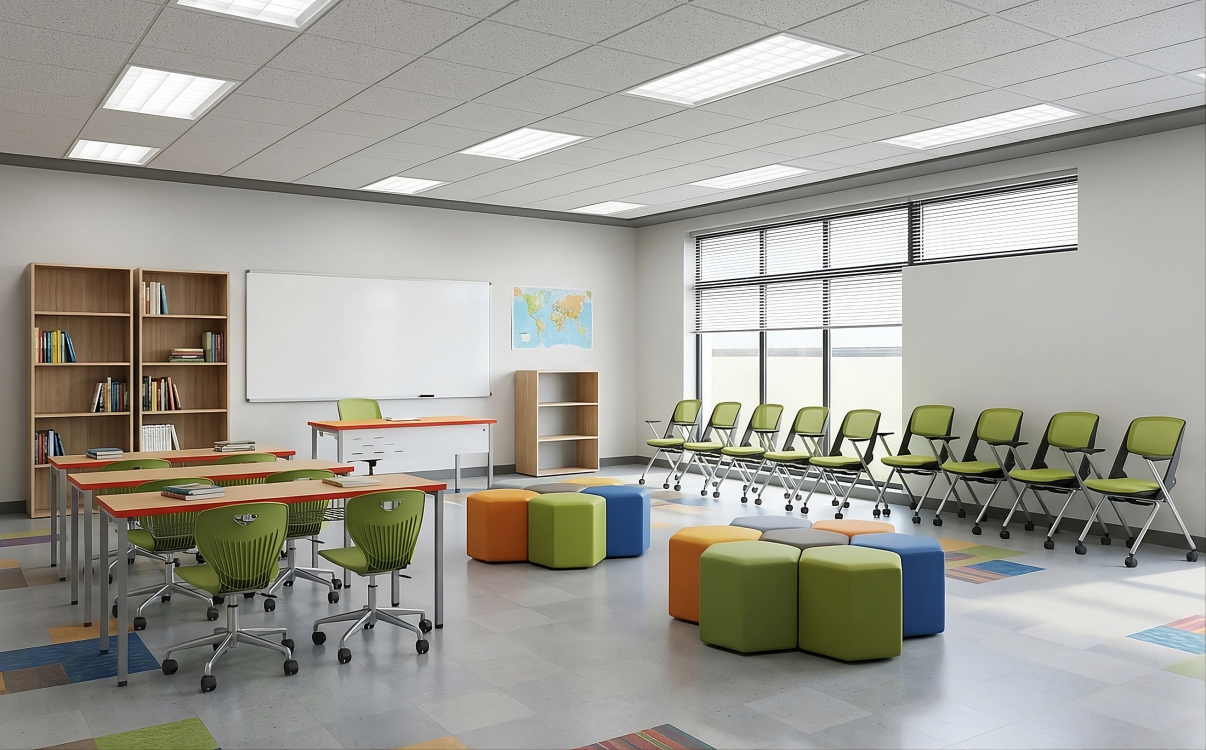

Bench Desk - Optimizing Lecture Hall and Classroom Space
Explore bench desks for lecture halls, classrooms, and training centers. Learn about their structure, advantages, how to choose, and outstanding models at RPB Education & Public right below.

Kích thước ghế băng chờ inox, nhựa, nệm: Bảng thông số chi tiết nhất
Cập nhật bảng kích thước ghế băng chờ inox, nhựa, nệm theo 2–5 chỗ ngồi; kèm cách bố trí lối đi, chọn thông số phù hợp từng không gian như bệnh viện, trường học, văn phòng, bến xe.

What is a Stool? Classification, Uses and Standard Sizes
Learn what a stool is, popular types of stools, practical uses, standard sizes, and how to choose the right stool for your home, school, restaurant, and office.

Office Relocation Announcement – Elevating Your Experience
To enhance service quality, expand our workspace, and provide a better experience for our customers, we are pleased to announce the relocation of our office to a new address.
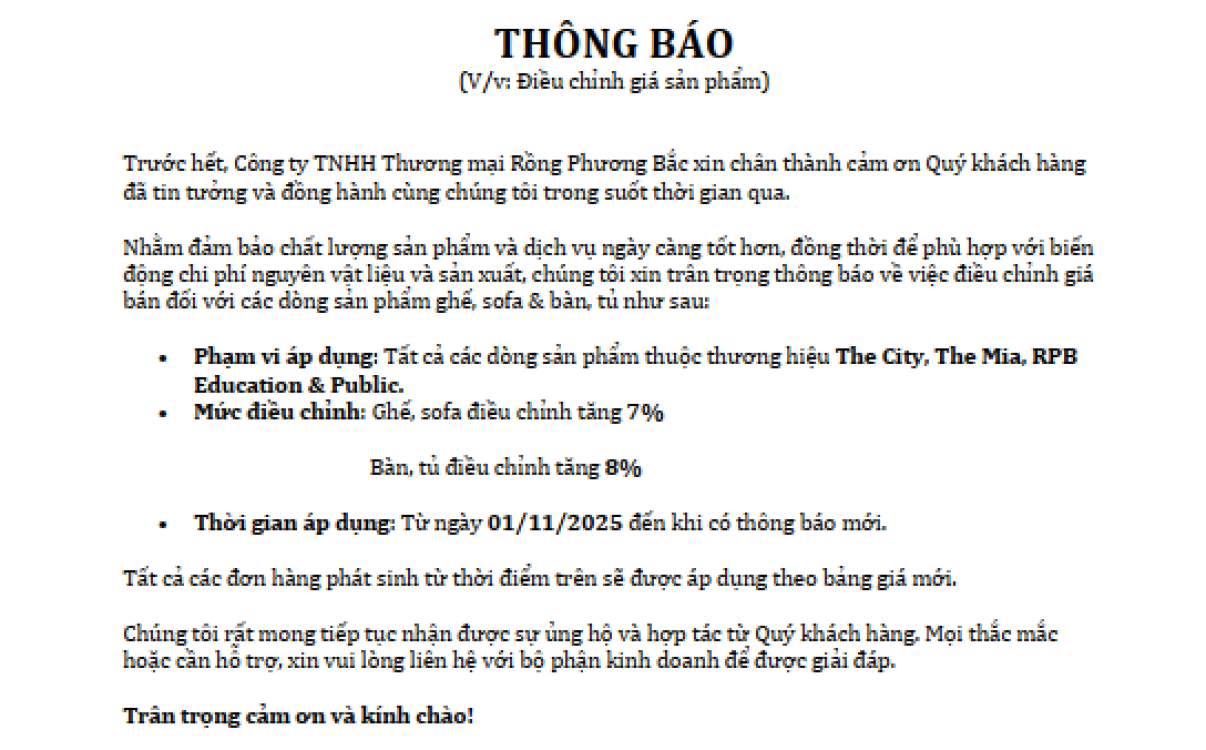
Announcement of product price adjustment
RPB Education & Public sincerely thanks our valued customers for your continued trust and partnership over the past years.
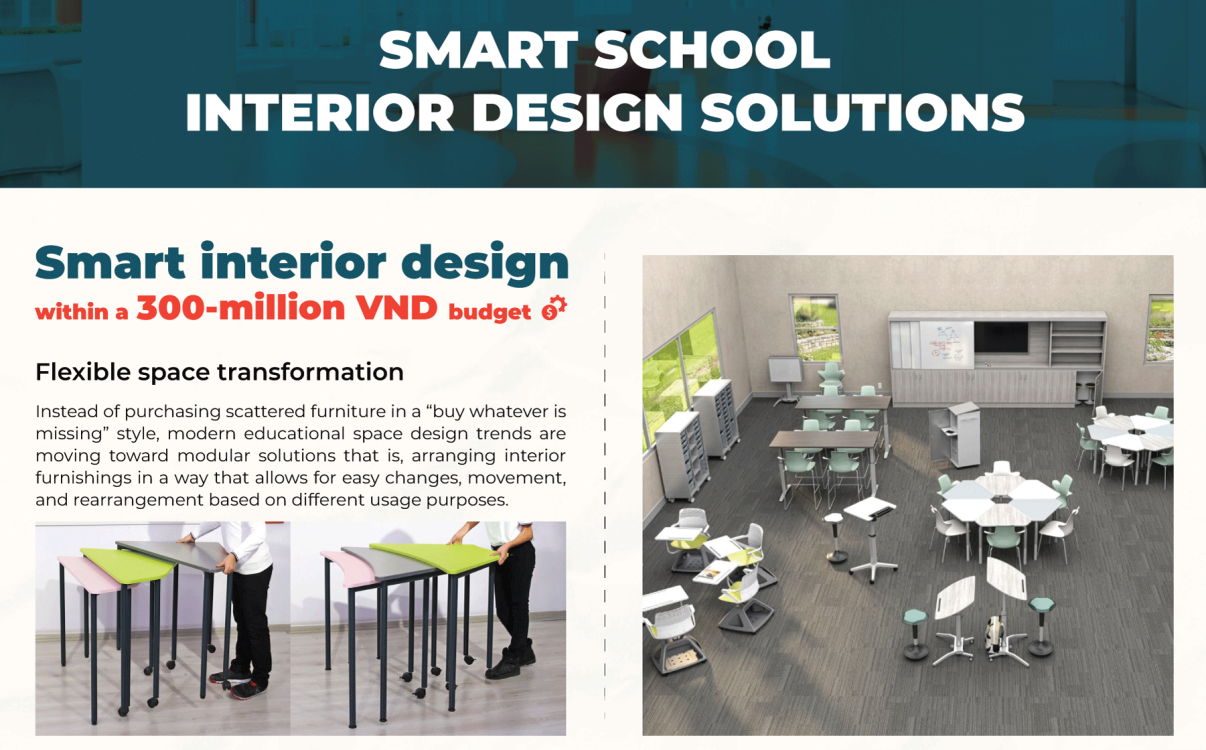
Smart Interior Design Solutions for Universities: Within a 300 Million VND Budget
Smart university interior design within a 300-million budget is not only a financial challenge but also a strategy to elevate the learning experience. With the right investment, it helps create modern, inspiring, and flexible spaces aligned with new teaching methods while optimizing long-term operating costs.

Environmental permit announcement
RPB Education & Public officially announces its environmental permit in accordance with current regulations, reaffirming the company's commitment to legal compliance, environmental protection, and sustainable development. This is an important step to ensure that all of RPB’s business and production activities are aligned with the goal of being environmentally friendly, safe for the community, and contributing to a greener future for the next generation.