


What to choose for 1st grade student desks and chairs for the new school year? Main keyword: 1st grade student desks and chairs
Preparing facilities for the new school year is one of the important tasks for primary schools, especially for the 1st grade. This is the stage when children begin to get acquainted with the formal learning environment, forming habits of sitting at desks, writing, and participating in class activities. Therefore, selecting desks and chairs for 1st graders needs careful consideration, not only based on design but also on suitability for body size, age, safety levels, and specific usage in schools.
A suitable desk and chair set helps students sit in the correct posture, feel comfortable throughout the lesson, and focus better. At the same time, standard-chosen desks and chairs contribute to creating a tidy, synchronized, and more professional classroom space for the new school year.
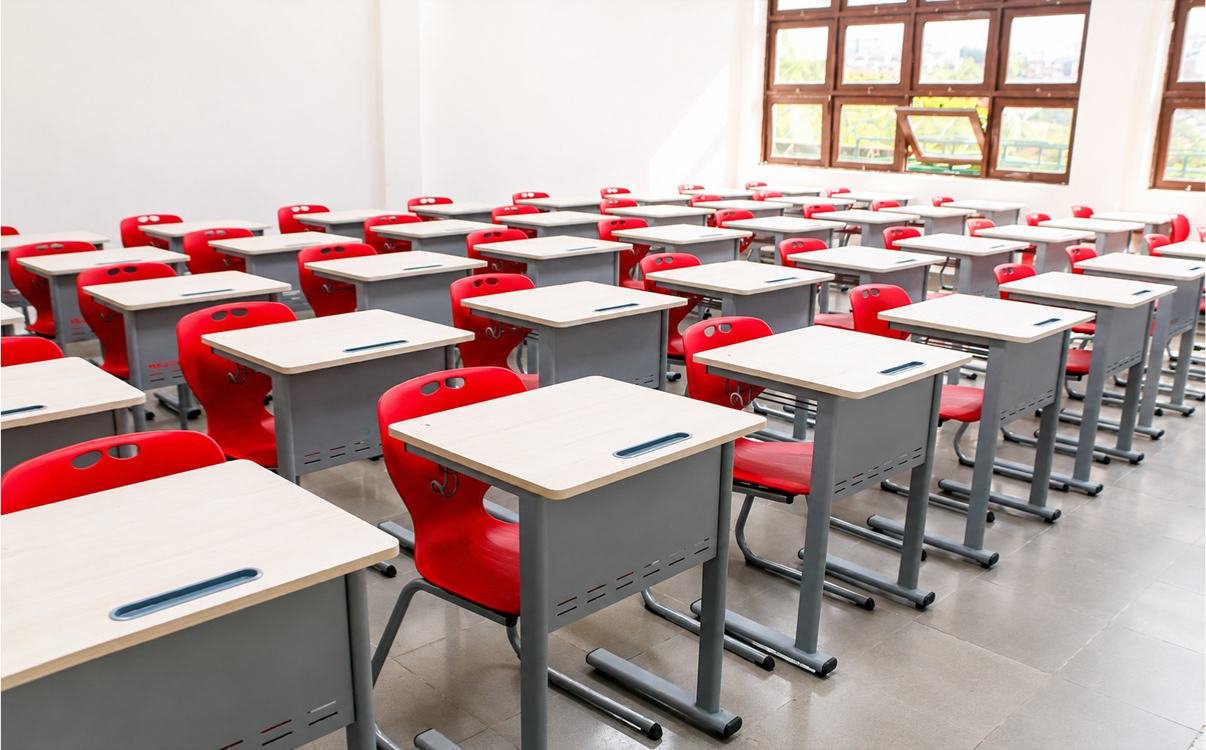
Why is it necessary to choose standard 1st grade student desks and chairs?
Helps children form correct sitting posture
1st grade students are typically 6-7 years old, their bodies are still developing and are easily affected by daily sitting posture. If the desk is too high, the chair too low, or the distance between desk and chair is not suitable, children may have to bend too close to their notebooks, hunch their shoulders, or sit skewed when writing.
Choosing 1st grade student desks and chairs of the right size helps children sit with a straight back, place their arms comfortably on the desk surface, and maintain a reasonable distance from books. This is an important factor to support long-term learning and helps children form scientific study habits right from their first years of primary school.
Ensures safety for young students
1st graders are still active, often moving around, standing up and sitting down, or bumping into things during learning and play. Therefore, desks and chairs used in classrooms need a sturdy structure, minimizing wobbling, and having no sharp details that could cause danger.
Desk and chair edges should be rounded or smoothly finished. The surface of desks and chairs needs to be safe for contact, easy to clean, and suitable for the educational environment. This is a crucial criterion to help schools minimize risks during daily use.
Creates comfort throughout the lesson
A school day for 1st graders usually lasts many periods, requiring children to sit focused for a certain amount of time. If the desk and chair are not suitable, children easily get tired backs, tired shoulders, feel uncomfortable, and lose concentration.
Desks and chairs with a height suitable for their body size help children place their feet comfortably on the floor, have their arms at the right level for the desk surface, and maintain a natural posture when writing. This comfort not only supports physical health but also contributes to improving learning quality in the classroom.
Helps the classroom become tidy and synchronized
Besides functional factors, desks and chairs directly affect the overall image of the classroom. Desk and chair sets with a synchronized design, suitable sizes, and easy arrangement help the classroom space become neater and more scientific.
For the new school year, investing in standard desks and chairs also demonstrates the school's meticulous preparation in building a safe, friendly, and professional learning environment for students.
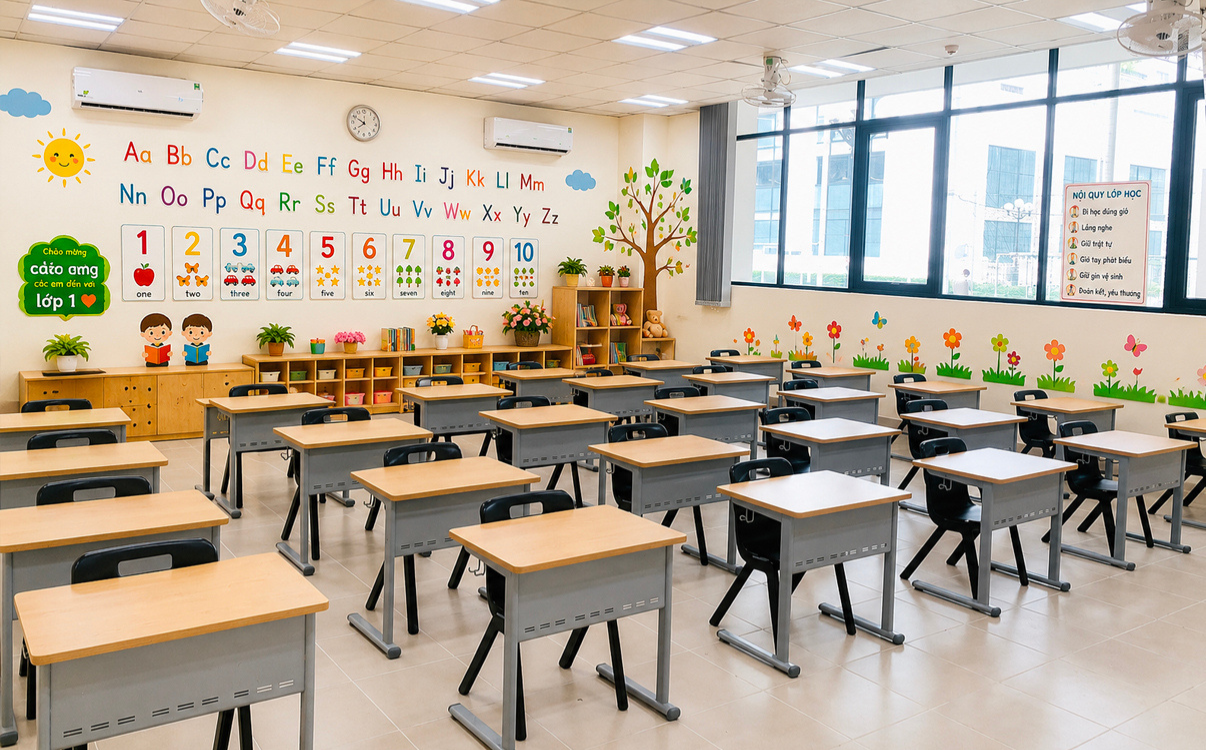
Criteria for choosing 1st grade student desks and chairs for the new school year
Size suitable for 1st graders' body shape
Size is the primary criterion when choosing desks and chairs for 1st graders. For 6-7 year old students, the desk and chair need appropriate heights so that when sitting, the child's feet can touch the floor comfortably, the back stays straight, and the arms reach the desk surface easily.
Schools should avoid choosing desks that are too high, forcing children to hunch their shoulders when writing, or chairs that are too low, making the sitting posture cramped. If possible, prioritize desk and chair models with clear specifications, suitable for different height groups of primary students.
Durable, beautiful, easy-to-clean materials
Desks and chairs in schools are used with high frequency, so materials need to ensure durability, load-bearing capacity, and ease of cleaning. Some popular choices include powder-coated steel frames, industrial wood tops, natural wood, high-quality plastic, or materials safe for the educational environment.
The desk surface should be smooth, easy to wipe clean, resistant to dirt, and suitable for daily learning activities. For schools with large student numbers, durable and easy-to-maintain materials help optimize long-term usage costs.
Safe design for young children
Desks and chairs for 1st graders need to be designed with safety as the top priority. Edges should be rounded, surfaces not rough, frames sturdy, and minimize sharp or obstructive details.
Furthermore, the desk and chair structure needs to be stable to prevent tilting, shaking, or excessive shifting when students use them. This is a particularly important factor in a classroom environment with many young children.
Design suitable for classroom space
Depending on classroom area and teaching models, schools can choose single desks, double desks, separate desks, or combined desk-chair units. For traditional classrooms, desks and chairs arranged in rows usually need a neat design that is easy to synchronize. For flexible classrooms, separate desks and chairs are more convenient for arranging in groups or changing layouts.
The design of desks and chairs should fit the overall space, helping teachers manage the class easily and students move conveniently.
Friendly colors that inspire learning
The color of desks and chairs also affects students' perception of the classroom. For 1st graders, prioritize gentle, bright, friendly colors that harmonize with the board, walls, cabinets, shelves, and other learning areas.
Schools should avoid overly bright colors or overly complex color combinations, as these can distract children. A harmoniously colored space will make the classroom pleasant and create a better learning inspiration.
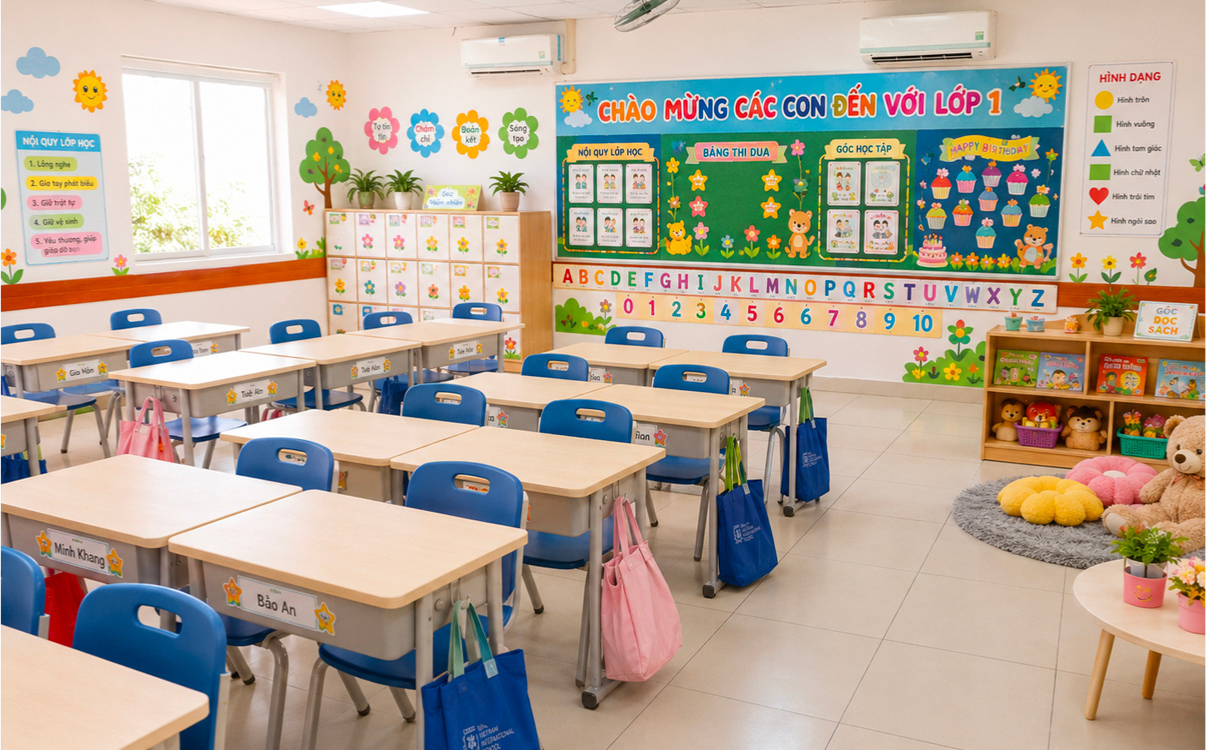
Popular types of desks and chairs for 1st graders today
Metal frame with wooden top desks and chairs for 1st graders
Desks and chairs with a metal frame and wooden top are a popular choice for many primary schools due to the balance between durability, safety, and long-term usability. This product line typically features a top made of industrial wood or Melamine-coated material, combined with a powder-coated steel frame to increase load capacity, limit rust, and suit the high-frequency classroom environment.
At RPB Education & Public, schools can consider the Hexa study desk for classrooms needing flexible layout arrangements. Hexa's standout feature is its hexagonal, round-cornered desktop design, which enhances safety when students move around the classroom and supports various arrangements such as individual study, group work, or interactive discussions. The desktop uses 18mm thick Melamine-coated MFC board, resistant to water absorption, scratches, and easy to clean; the legs are powder-coated steel with anti-slip plastic tips protecting the floor.
For 1st grade classrooms, the Hexa desk suits spaces wanting a more dynamic learning feel instead of only traditional row arrangements. The hexagonal design helps teachers easily organize small group activities, encouraging students to interact, discuss, and get used to the new learning environment. The product comes in various heights such as 620mm, 650mm, 720mm, and 750mm, with the lower sizes being more suitable for primary students or classes needing low study desks.
See more product: Hexa Study Desk
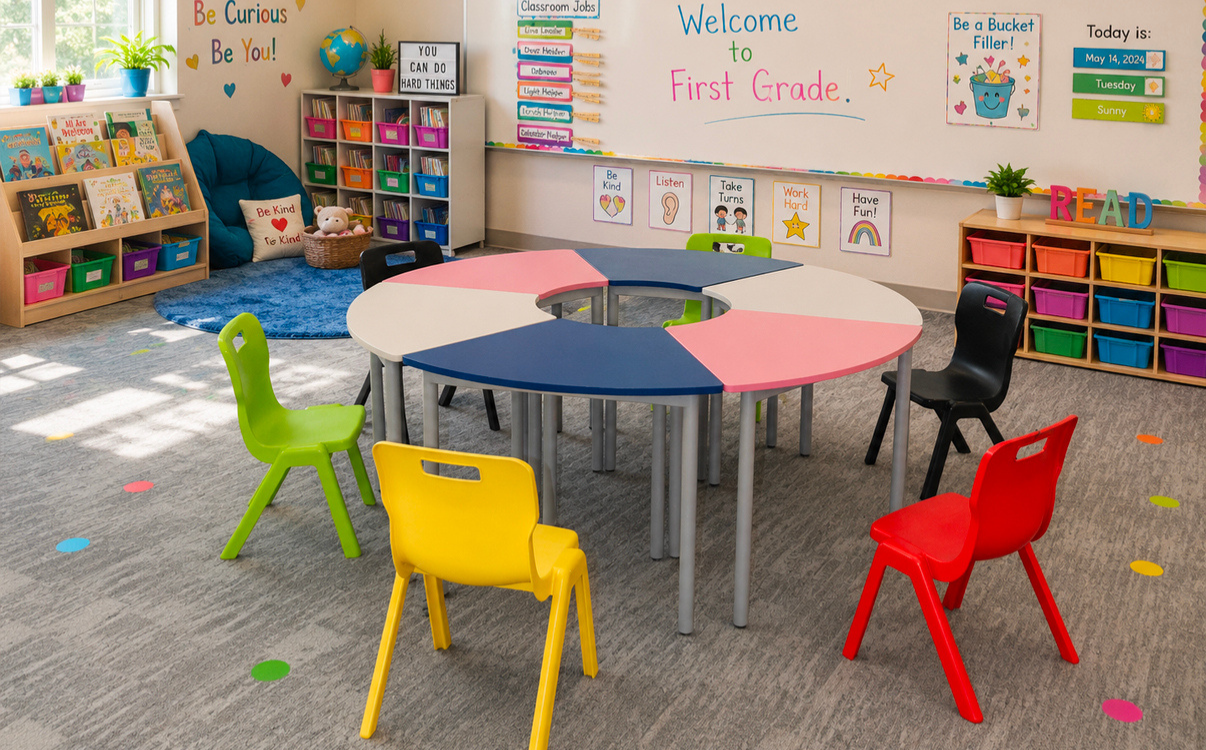
Wooden desks and chairs for 1st graders
Wooden desks and chairs or those with wood-grain surfaces for 1st graders often bring a friendly, close feeling and easily blend with primary classroom spaces. This is a suitable choice for schools wanting to build a warm, meticulous learning environment while still ensuring durability and convenience for daily use.
For this product group, RPB Education & Public offers the Zico 01 - V school desk. The product is designed for modern classrooms, focusing on both function and aesthetics. The desktop is made of 18mm thick Melamine-coated MFC board, resistant to scratches, moisture, and easy to clean. The leg frame uses oval 30×60mm powder-coated steel, making the desk sturdy, with good load capacity, suitable for frequently used classroom environments.
The Zico 01 - V desk is also equipped with a leg shield matching the desktop, a steel under-desk compartment for students to store books, and accessories like bag hooks and a pen tray. These are small but very useful details for 1st graders, as children often need clear space to organize their school supplies, preventing backpacks, pencil cases, or notebooks from becoming messy underfoot.
With a desktop size of 700mm x 500mm and multiple height options from 650mm to 750mm, the Zico 01 - V can be selected according to student height groups or grade levels. For 1st grade, schools should prioritize sizes suitable for children's bodies so they can sit up straight, place their arms comfortably on the desk, and see the board more conveniently.
See more product: Zico 01 - V School Desk
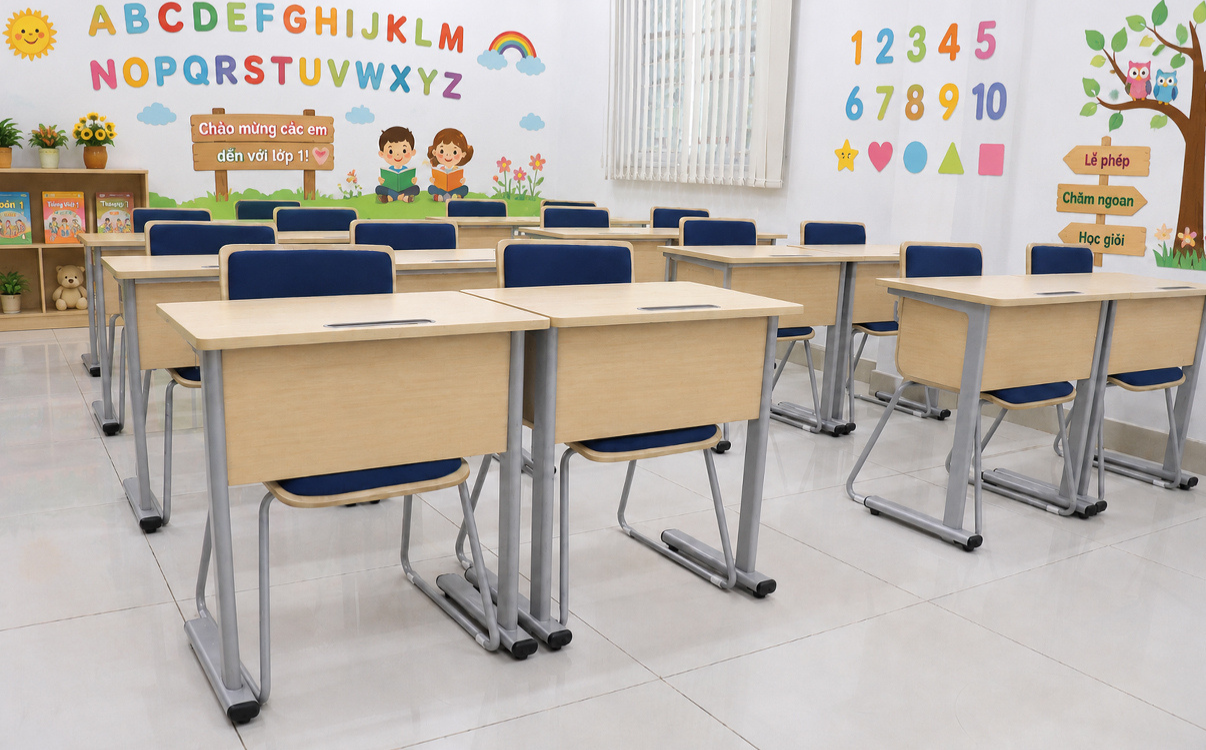
Separate desks and chairs for 1st graders
Separate desks and chairs for 1st graders suit classrooms needing flexibility in layout. Instead of being fixed in one arrangement, separate desks and chairs help teachers easily change the space from individual study to group work, from row arrangements to clusters or semicircles. This is a worthwhile choice for primary schools moving towards interactive classroom models, increasing group activities, and encouraging students to be more proactive during lessons.
At RPB Education & Public, the Eco 01 school desk is suitable for this need. The product has a minimalist design, a 700mm x 500mm desktop, providing enough space for 1st graders to write, read, and place necessary learning materials. The desk integrates a mesh hutch underneath for storing books and has bag hooks on both sides, keeping the seating area tidy and minimizing obstructions when students move.
Regarding construction, Eco 01 uses an 18mm thick Melamine-coated MFC desktop, with PVC edge banding to limit chipping and enhance safety for young students. The legs are an inverted C-frame made of oval 30x60mm steel tube, powder-coated against rust, combined with rubber feet for anti-slip and noise reduction during use. These are important factors for primary classrooms where students frequently stand up, sit down, and move around during lessons.
Eco 01 offers height options of 650mm, 680mm, 720mm, and 750mm. For 1st graders, schools should compare the actual student heights with classroom layout standards to choose the appropriate size, avoiding desks that are too high, forcing children to hunch their shoulders or bend over when writing.
See more product: Eco 01 School Desk
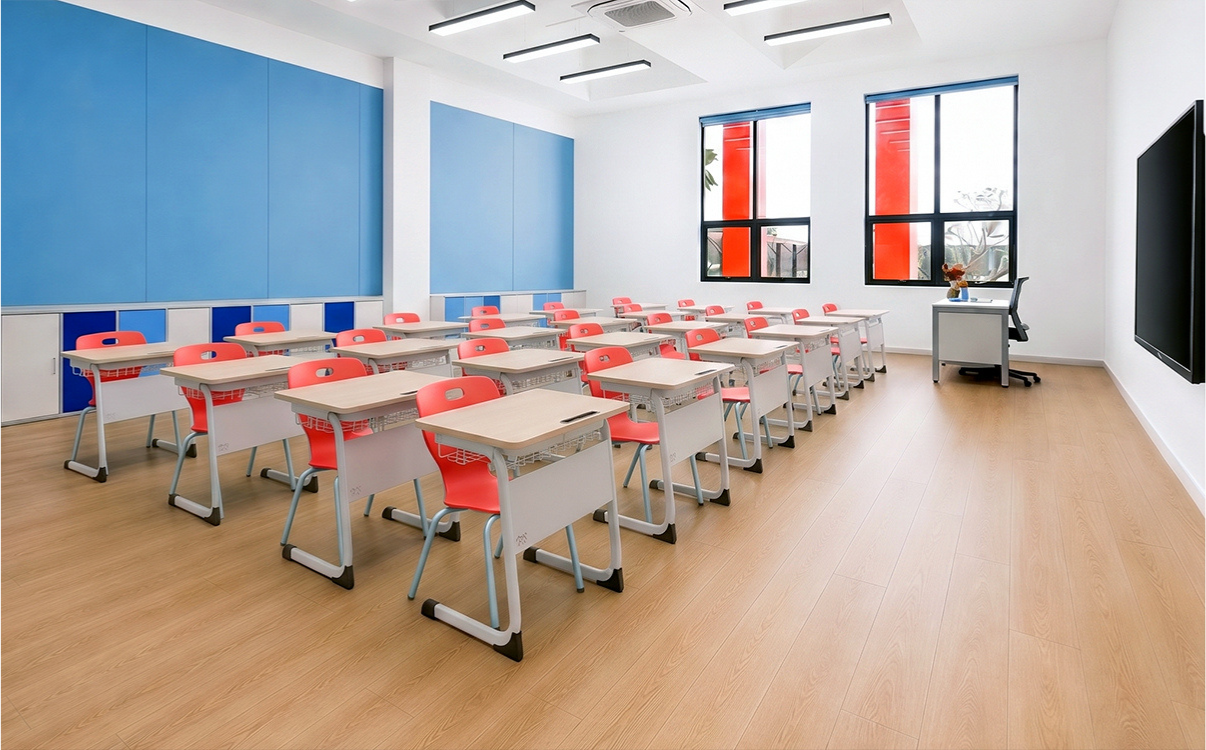
Combined desk-chair units for 1st graders
Combined desk-chair units for 1st graders suit classrooms needing to optimize area, maintain a neat layout, and prevent desks and chairs from shifting during use. This product line is often chosen for learning spaces, training rooms, self-study rooms, or classrooms needing many seats while still ensuring tidiness.
At RPB Education & Public, the Moto 07 training chair is a suitable suggestion for spaces needing compactness, durability, and easy cleaning. The product has a backrest and seat made of high-quality hard plastic, making cleaning after prolonged use convenient. The armless design saves space, easy to arrange in rows or clusters, especially suitable for classrooms, meeting rooms, tutoring centers, or training spaces needing many seats.
The Moto 07 chair's legs use powder-coated steel, with a fixed C-shaped design, providing sturdiness and stability during use. For 1st graders, the compact, armless design helps children get in and out of their seats more easily, while assisting schools in arranging a spacious and manageable classroom.
See more product: Moto 07 Training Chair
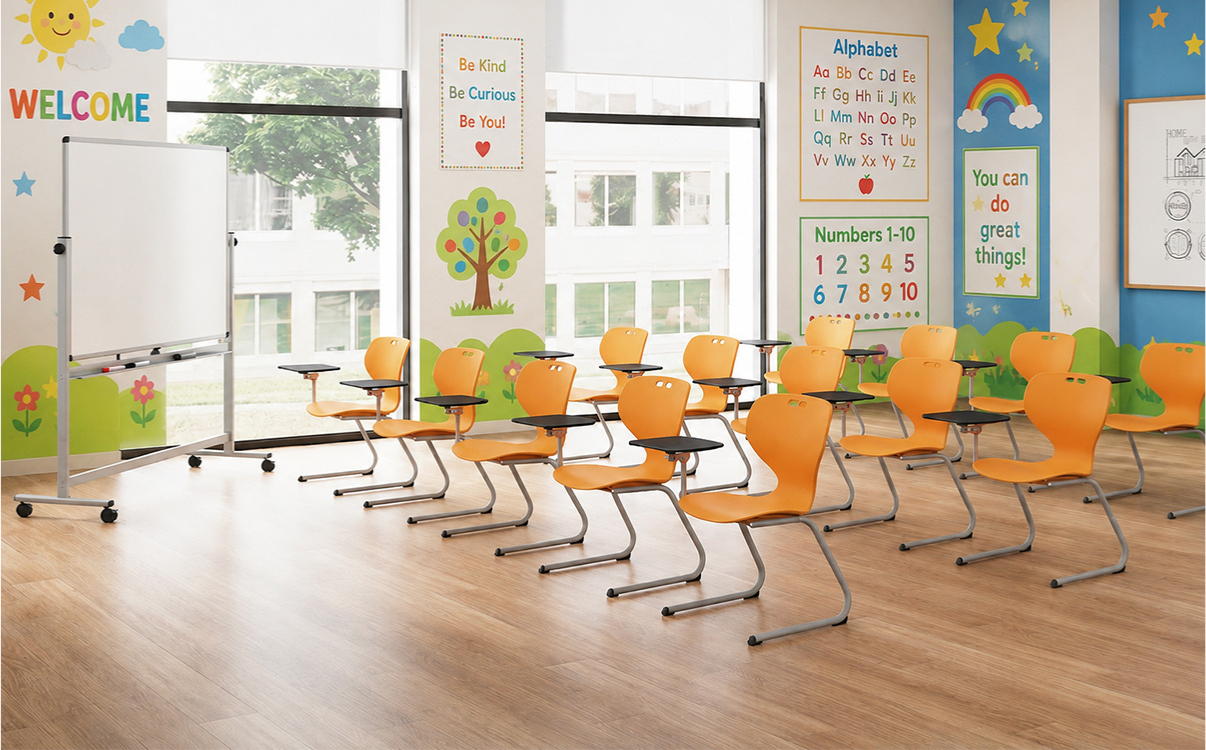
Height-adjustable desks and chairs for 1st graders
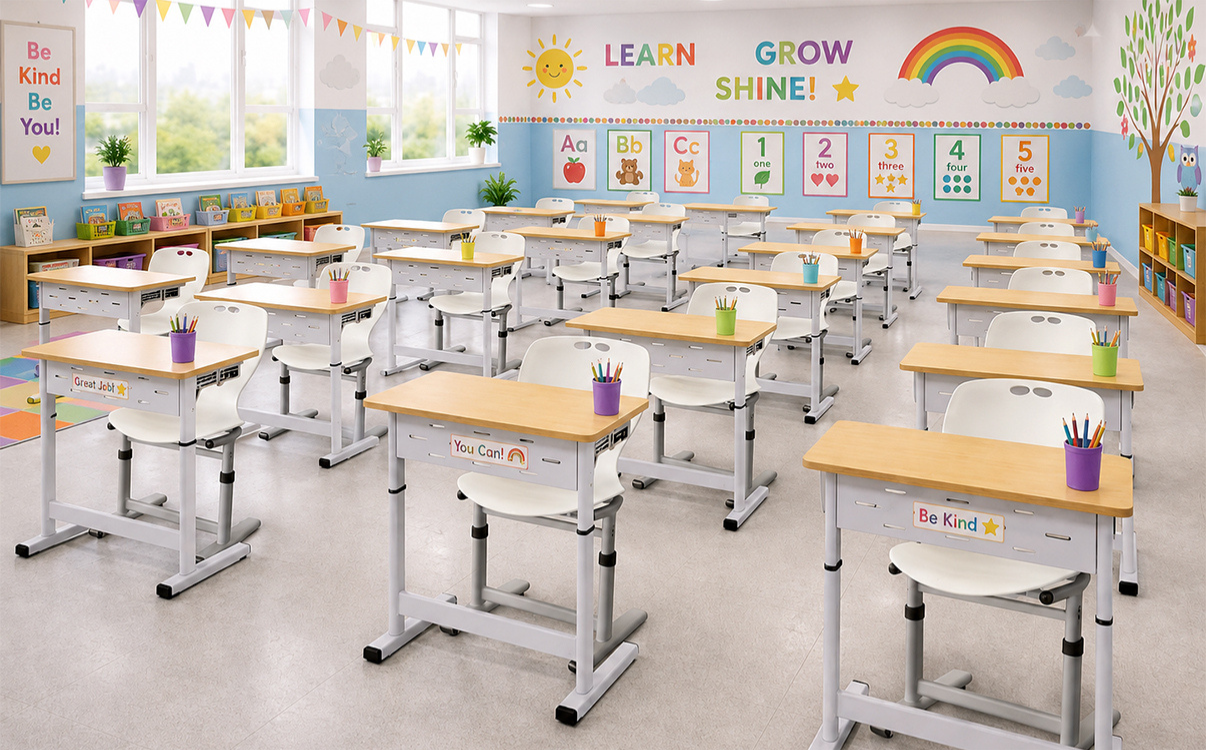
Height-adjustable desks and chairs for 1st graders are a suitable choice for schools wanting to maximize product lifespan and accommodate differences in student body sizes. Within the same grade, children's heights can vary significantly, so adjustable desks and chairs give schools more flexibility when arranging classrooms and help students maintain correct sitting posture.
A standout option at RPB Education & Public is the Smart Zico adjustable desk. The product features flexible height adjustment, suitable for various ages and body types. The desktop is 700mm wide and 500mm deep, using 18mm thick Melamine-coated MFC board, resistant to scratches, moisture, and easy to clean. The desk leg frame uses oval 30×60mm powder-coated steel tube, with good load capacity, rust resistance, and wobble resistance.
Smart Zico also features a steel mesh under-desk compartment, a pen tray, and a bag hook, helping students organize their personal space more neatly. The desk height can be adjusted from 600mm to 750mm, suitable for various stages of student development and allowing schools to use it flexibly for different grade levels.
Alongside the adjustable desk, schools can combine it with the Moto II adjustable chair to increase suitability according to student body shape. The chair has a minimalist design, armless, with backrest and seat made of high-quality plastic, easy to clean, combined with a rust-resistant powder-coated steel frame. The product has adjustable height, helping students adjust their sitting posture more appropriately during learning.
For 1st grade classes with many students of varying heights, the Smart Zico adjustable desk paired with the Moto II chair is a worthwhile option. This solution helps schools avoid situations where students sit at desks that are too high or chairs too low, thereby supporting correct sitting posture, reducing back and shoulder fatigue, and creating more comfort throughout the school day.
See more product: Smart Zico Adjustable Desk
See more product: Moto II Adjustable Chair
Which need should determine the choice of desks and chairs for 1st graders?
Choosing desks and chairs for 1st graders should not rely solely on design or price but must stem from the actual usage needs of each school type. Each educational model has its own characteristics regarding student numbers, usage frequency, investment budget, teaching methods, and direction for building classroom space. Therefore, schools need to clearly define their goals before selecting products to ensure the desks and chairs are both suitable for students and optimize long-term investment efficiency.
For public schools
For public schools, desks and chairs are typically used by a large number of students for many consecutive years. Therefore, the top priorities are durability, load-bearing capacity, ease of maintenance, and reasonable cost. Desk and chair models with sturdy structures, powder-coated steel frames, easy-to-clean desktops, and simple designs are suitable for high-frequency learning environments.
For 1st graders, schools should choose desks and chairs with sizes appropriate for 6-7 year old children, avoiding desks too high or chairs too low that cause incorrect posture. Additionally, details like rounded table corners, smooth surfaces, sturdy legs, and minimized wobbling are crucial to ensure safety during daily student use.
Operationally, public schools often need to purchase in large quantities, so desk and chair models with synchronized designs, easily replaceable parts, and easy classroom arrangement will help schools conveniently manage, maintain, or supplement in subsequent school years. This need group suits durable, budget-optimized desk and chair models that still meet educational environment standards.
For private schools and international schools
For private and international schools, desks and chairs for 1st graders not only need to meet basic functions but also align with the goal of building a modern, friendly, and experience-rich school image. Classroom spaces are often given more attention regarding color, aesthetics, flexibility, and support for new teaching methods.
Schools can prioritize separate desks, group desks, or flexibly designed tables for easy changes to classroom layout. Within a single lesson, a teacher might need to switch from individual study to group work, discussion, practice, or creative activities. In that case, easily movable desks and chairs that can be combined into different clusters help the classroom become more dynamic.
Furthermore, desk and chair colors should be carefully considered. Bright, gentle colors or those harmonizing with the space's identity will make the 1st grade classroom feel friendly, lively, and inspiring for students. However, schools should avoid overly bright colors or too many colors in one space as they can be distracting and affect children's concentration.
For this school group, desks and chairs are not just classroom equipment but part of the educational experience. Therefore, choose products with modern design, safety, easy cleaning, and suitable for flexible learning models.
For renovated classrooms in the new school year
For renovated classrooms before the new school year, the most important factor is suitability with the existing space. Schools need to consider classroom area, student numbers, board position, cabinet system, doors, lighting, and walkways before choosing desks and chairs. Replacing desks and chairs without considering the overall space can lead to a cramped classroom, difficult movement, or lack of harmony with existing furniture.
In a quick renovation situation, schools should prioritize compact desk and chair models that are easy to install, transport, and have standard sizes. This helps shorten implementation time, minimizing impact on the opening ceremony schedule. Desk and chair models with simple designs, neutral colors, and easy integration with the old space will help refresh the classroom without replacing all furniture.
Additionally, for renovated classrooms, schools should carefully check the compatibility between new desks and chairs and existing items like boards, storage cabinets, podiums, bookshelves, or bag storage areas. Desks and chairs need to be arranged to ensure walkways, board visibility, and safe distances between rows.
This need group suits desk and chair models with neat designs, easy synchronization, and quick implementation based on the actual number of classrooms.
For new school construction projects
For new school construction projects, selecting desks and chairs for 1st graders should be part of an overall educational furniture solution, rather than choosing individual products. From the early stages, schools should clearly define the classroom model, number of students per class, teaching methods, aesthetic direction, and investment budget to have a suitable desk and chair plan.
Student desks and chairs need to be synchronized with other items such as cabinets, shelves, boards, personal storage areas, reading corners, group study areas, and common activity spaces. When items are designed consistently, the classroom has higher aesthetics, clearer functionality, and helps students use the space orderly.
For 1st grade, new school projects also need to pay attention to the psychological transition for children. This is the stage when students move from kindergarten to primary school, so the classroom should feel safe and friendly but still have discipline and focus. Desks and chairs should have suitable sizes, harmonious colors, a design that is not too heavy, and easily support various learning activities.
For new projects, schools should also work with a supplier experienced in school furniture to get advice on an overall solution. This ensures that desks and chairs are not only beautiful and durable but also suitable for usage standards, implementation schedules, investment budgets, and the school's long-term development direction.
How to arrange 1st grade student desks and chairs in the classroom
Besides choosing the right model of desks and chairs for 1st graders, the classroom layout directly affects student comfort, visibility, concentration levels, and safety. For 1st graders, the classroom space needs to be arranged clearly, easy to move around in, and suitable for the psychological characteristics of this age group just starting primary school.
A reasonable layout helps teachers manage the class easily, support students promptly, and organize learning activities more effectively. Depending on classroom area, student numbers, and teaching methods, schools can choose an appropriate arrangement.
Traditional row arrangement
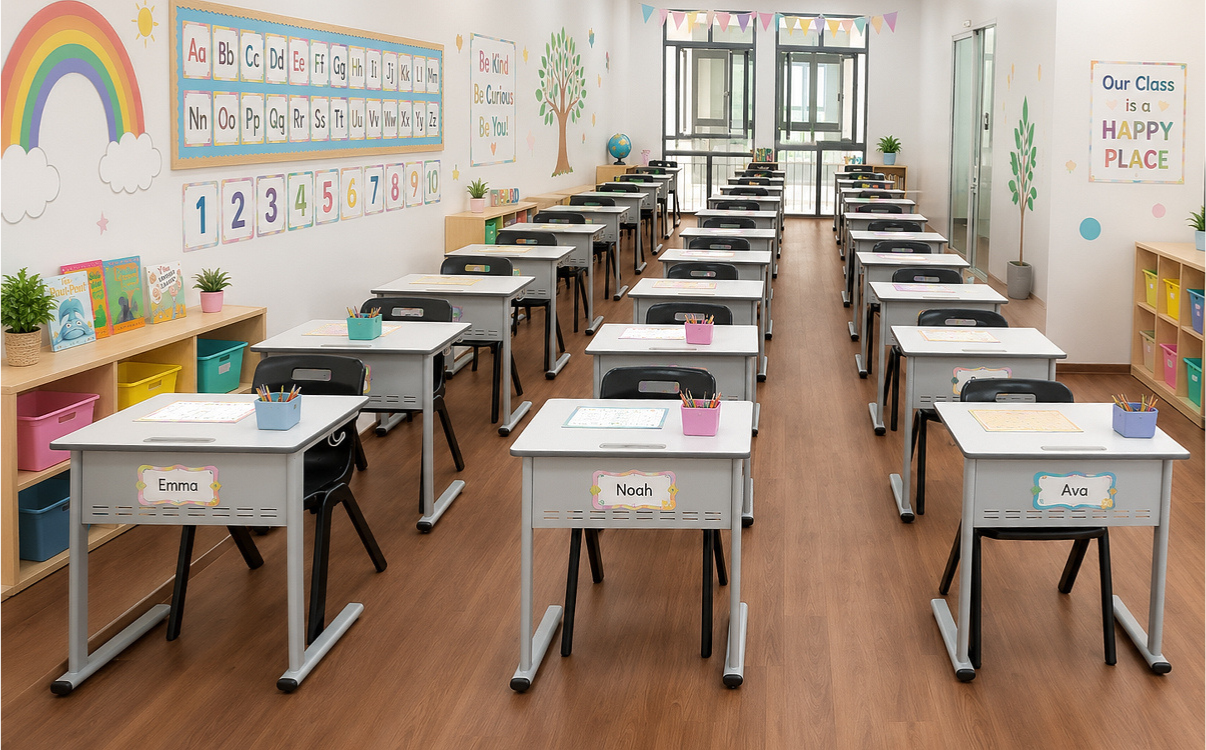
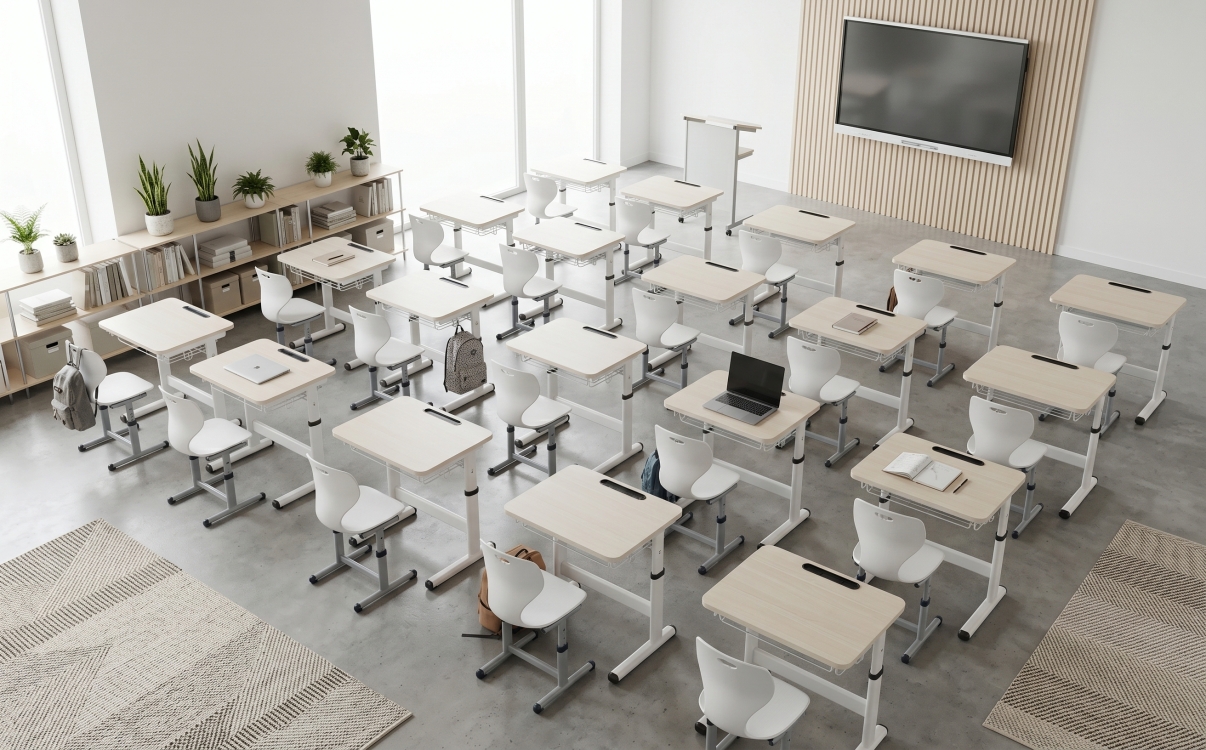
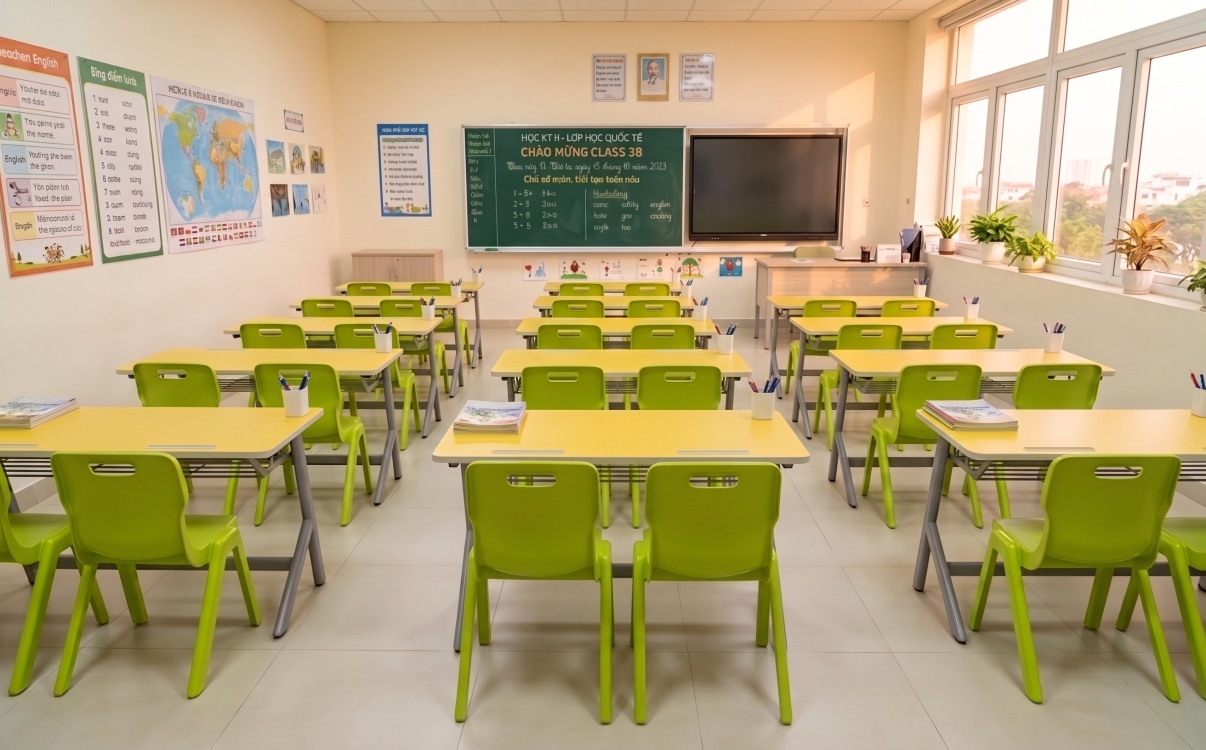
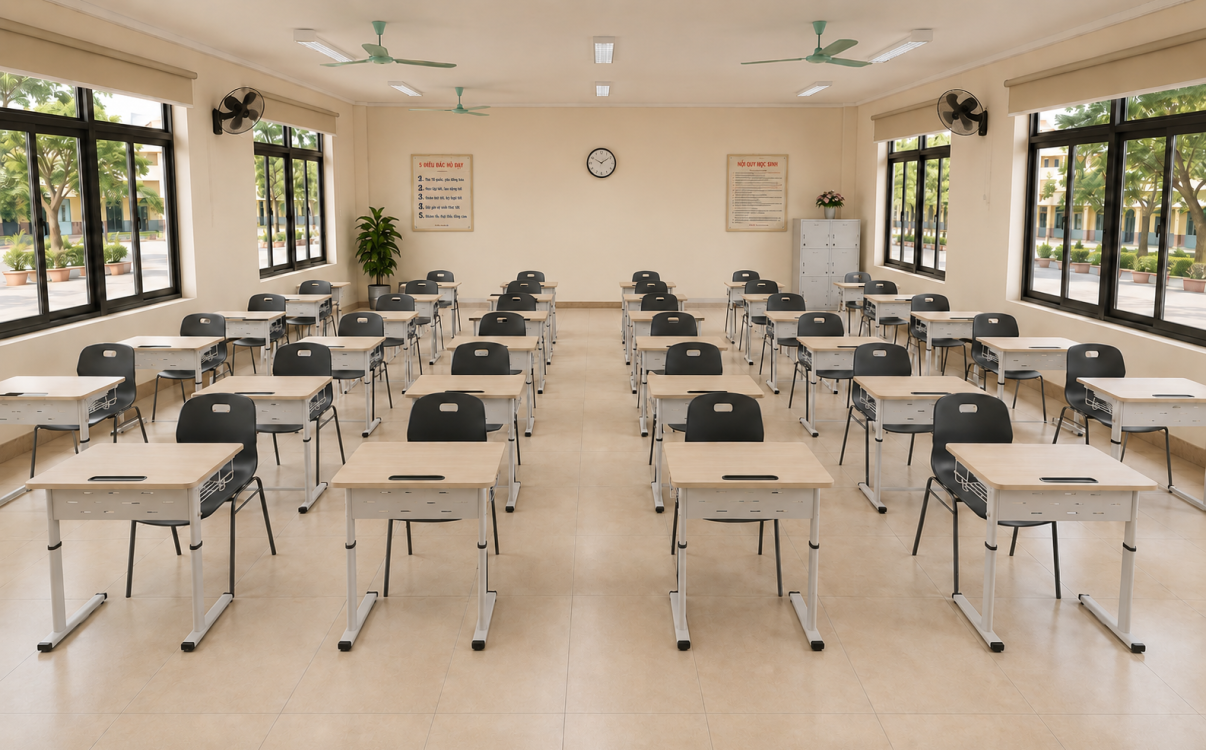
Arranging desks and chairs in traditional rows is a familiar setup in many primary classrooms. Desks are placed parallel in rows, facing the board and the teacher's desk. This arrangement suits basic classrooms where the teacher needs to deliver knowledge, guide writing and reading, and manage students by rows.
The advantage of row arrangement is creating order, helping students focus easily on the lesson and see the board clearly. The teacher can also oversee the entire class, easily identifying which students need support or are not paying attention.
When arranging in rows, schools should ensure the distance between desks is not too tight. Each student needs enough space to sit, place their backpack, get learning materials, and move in and out of their seat. For 1st graders, a reasonable distance also helps minimize bumps when they stand up, turn around, or move during the lesson.
This layout suits single desk, double desk models, or fixed design desk-chair units, especially in crowded classes or those needing stability during teaching.
Small group arrangement
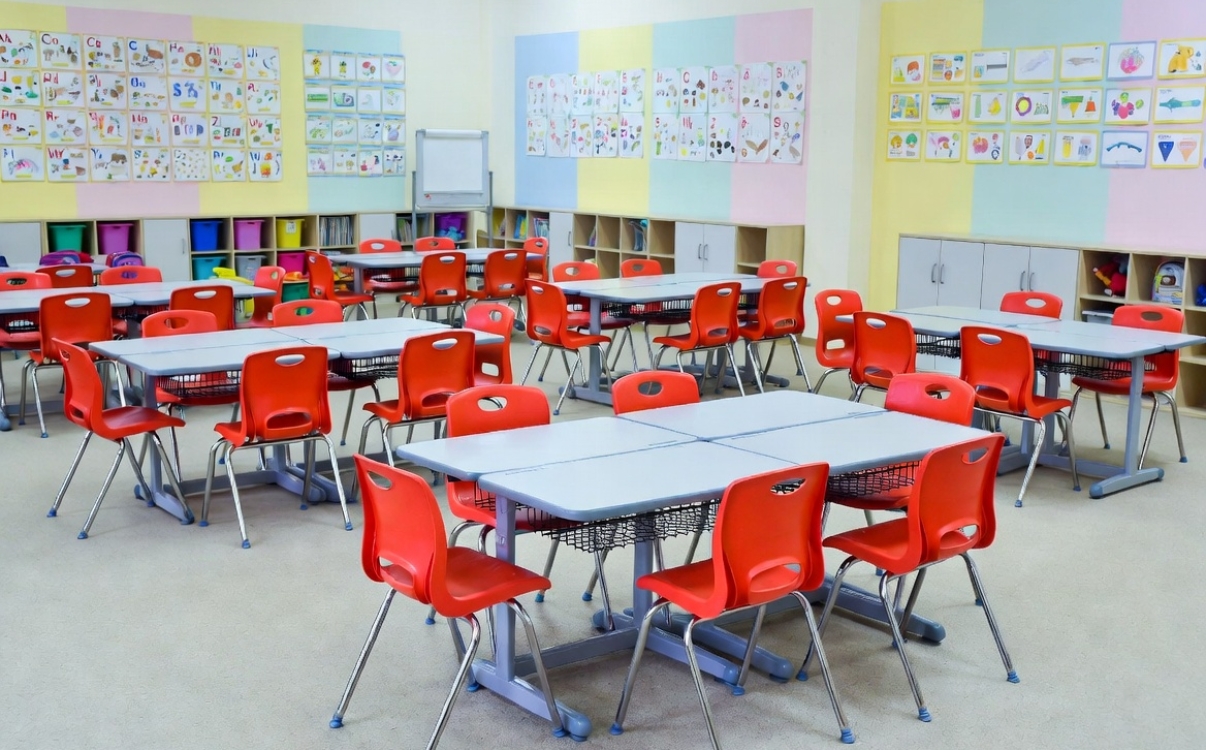
Arranging desks and chairs in small groups suits classrooms oriented towards interaction, discussion, and group activities. Instead of lining up all desks in rows, teachers can cluster desks into groups of 4-6 students so they can easily exchange ideas, work together, and participate in creative activities.
For 1st graders, this arrangement helps children get acquainted with collaboration, communication, and sharing skills in learning. This layout is also suitable for art, crafts, storytelling, experiential activities, or lessons needing students to practice together.
However, when arranging in small groups, schools need to control the distance between clusters so the classroom does not become crowded. The teacher also needs to ensure every student can still see the board when listening to general instructions. If desks and chairs are too heavy or hard to move, changing the layout takes time and disrupts the lesson.
Therefore, for this model, prioritize separate desk and chair models with compact sizes, easy movement, and safe design. Desk edges should be rounded, legs sturdy to ensure safety during group activities.
Ensuring walkway space
Walkway space is a very important factor when arranging desks and chairs for 1st graders. 1st graders tend to move around more than older students, and they are not yet fully accustomed to maintaining order in the classroom. If desks and chairs are placed too close together, students easily bump into desks, chairs, or neighbors when getting in and out of their seats.
Walkways need to be wide enough for teachers to move down each row, observe writing, help students adjust sitting posture, or provide guidance when needed. For students, clear walkways make it easy to get in and out of seats, minimizing jostling during transitions, getting supplies, or participating in class activities.
Schools should arrange main walkways in the middle or along both sides of the classroom, depending on room area and number of desks and chairs. Additionally, pay attention to areas near doors, boards, storage cabinets, and the teacher's desk to avoid congestion when students move simultaneously.
A classroom with reasonable walkways is not only safer but also helps teachers organize the class effectively, especially during lessons requiring material distribution, homework checks, or instructing student groups.
Ensuring board visibility
Board visibility directly affects the learning absorption of 1st graders. At this age, children are just beginning to get acquainted with writing, numbers, and content presented on the board, so clear viewing is essential.
When arranging desks and chairs, schools should avoid placing desks too far from the board, too close to the board, or in obstructed positions. Students sitting too far may have difficulty seeing letters, while those sitting too close may have to crane their necks, causing eye strain and discomfort over long periods. Rows should not be too skewed relative to the board, as this may force students to constantly turn their bodies to follow the lesson.
For crowded classrooms, teachers should check visibility from various positions to ensure students in the back rows and corners can still see the board comfortably. If the classroom uses interactive screens, projectors, or auxiliary boards, desk positions should also be adjusted to prevent glare or obstruction by students in front.
Notes when buying desks and chairs for 1st graders for the new school year
When preparing desks and chairs for 1st graders for the new school year, schools should not choose solely based on design or initial price. This product group is used daily, with high frequency, directly affecting sitting posture, safety, and the learning experience of students. Therefore, before placing an order, carefully evaluate factors from size, material, durability, safety to the supplier's capability.
Carefully check desk and chair dimensions before ordering
Size is the most important factor when choosing desks and chairs for 1st graders. 1st graders are typically 6-7 years old, with uneven height and build, so desks and chairs need to be chosen to suit the majority of students in the class.
When sitting, students should be able to place their feet comfortably on the floor, keep their back straight, have their arms reach the desktop at the right level, and maintain a reasonable eye distance from books. If the desk is too high, children may hunch their shoulders when writing. If the chair is too low or too high, children may experience back and neck pain, sitting in poor posture for long periods.
Therefore, before ordering, schools should carefully check desk height, chair height, desktop width, and the distance between desk and chair. For classes with many different height groups, consider adjustable desks and chairs or choose multiple sizes suitable for each student group.
Prioritize products with clear specifications
A suitable student desk and chair product needs transparent technical specifications. Schools should prioritize models with full information on dimensions, desktop material, frame material, desktop thickness, paint type, load capacity, included accessories, and warranty policy.
Clear specifications help schools easily compare products and minimize the risk of choosing unsuitable desks and chairs for 1st graders. This is also an important basis when purchasing in large quantities, budgeting, or approving investment plans for the new school year.
For the school environment, prioritize products with durable materials, easy-to-clean surfaces, sturdy frames, minimized wobbling, and safely finished details that contact students.
Choose a supplier experienced in school furniture
Student desks and chairs are not like ordinary furniture. The product needs to suit the age group, usage frequency, classroom area, safety standards, and teaching methods of each school. Therefore, schools should choose a supplier experienced in educational furniture.
A specialized supplier will not only provide products but also advise on how to choose desks and chairs based on student numbers, classroom area, layout type, budget, and implementation schedule. This is especially important for schools renovating classrooms, preparing facilities before the opening ceremony, or implementing new school projects.
Practical implementation experience also helps the supplier offer more suitable options, avoiding the situation of choosing beautiful products that are not optimal for daily use.
Order early to meet the opening ceremony schedule
Before the new school year, the demand for purchasing and renovating facilities in schools is usually high. If orders are placed too close to the opening ceremony, schools may face risks regarding production, transportation, installation, or handling unexpected issues.
To ensure classrooms are completed on schedule, schools should proactively survey needs, finalize quantities, and order early. Early preparation allows more time for sample checking, size reviews, agreeing on layout plans, and handling related items like cabinets, boards, bag storage, or common activity spaces.
For large quantity orders, ordering early also helps schools better control quality, delivery schedule, and installation plans by class, floor, or area.
Check warranty, transport, and installation policies
When buying desks and chairs for 1st graders, schools should carefully check accompanying policies such as warranty, transport, installation, returns, or support for defective products. These factors directly affect long-term use.
For the school environment, desks and chairs are used continuously, so warranty and after-sales support are very important. A good product needs clear policies to give schools peace of mind during operation, especially when purchasing large quantities for multiple classrooms.
Additionally, transport and installation services need careful planning. Desks and chairs must be delivered on time, in the correct quantity, installed in the right positions, and safe before handover to the school.
Balance quality, durability, aesthetics, and budget
Budget is an important factor but should not be the sole criterion when choosing desks and chairs for 1st graders. A low-priced product that deteriorates quickly, is hard to clean, or is unsuitable for student body size may incur additional repair or replacement costs in a short time.
Instead, schools should balance quality, durability, aesthetics, and investment budget. A suitable product meets actual usage needs, has good longevity, is safe for students, and harmonizes with the classroom space.
For the new school year, investing in suitable desks and chairs not only makes the classroom tidier and more synchronized but also enhances the learning experience for students right from their first days at school.
Reputable supplier of desks and chairs for 1st graders
To choose suitable desks and chairs for 1st graders, schools should prioritize suppliers experienced in educational furniture, with a diverse product catalog and the ability to advise according to actual needs. A reputable supplier will help schools not only choose the right desk and chair model but also optimize the layout plan, budget, and implementation schedule for the new school year.
Choose a supplier with many models of primary student desks and chairs
A reputable supplier needs to have various product lines suitable for primary students, especially 1st graders. Desk and chair models should be diverse in design, size, and function, such as separate desks and chairs, combined units, adjustable desks, group desks, metal frame with wooden top, or chairs suitable for young children's body sizes.
Product diversity helps schools easily choose according to each classroom model. For traditional classrooms, prioritize durable desks and chairs, easy to arrange in rows. For modern or flexible classrooms, choose separate desks and chairs, easy to change layout for group activities and interaction.
Ability to advise based on classroom area, student numbers, and budget
Not every classroom has the same area, class size, and layout style. Therefore, schools should choose a supplier capable of advising based on actual floor plans, student numbers, usage needs, and investment budget.
For classrooms with limited area, the supplier needs to advise on compact desk and chair models, easy to arrange while ensuring walkways. For crowded classes, prioritize sturdy, synchronized, easy-to-manage products. For private or international schools, a solution with higher aesthetic value, harmonious colors, and suitable for space identity may be needed.
Correct advice from the start helps schools avoid buying unsuitable desks and chairs, leading to a cramped classroom, difficult movement, or needing to redo after installation.
Products with clear materials, standard design, suitable for the educational environment
Desks and chairs used in schools need clear materials and a design suitable for young students. Schools should prioritize products with sturdy frames, easy-to-clean surfaces, safely finished edges, and stable structures during use.
For 1st graders, safety needs extra attention. Desks and chairs should minimize sharp edges, have no obstructive details, not be too heavy to cause difficulty in arrangement, but also not too light, making them prone to shifting or instability.
A product suitable for the educational environment must simultaneously meet many factors: safety, durability, easy cleaning, easy maintenance, suitability for student body size, and harmony with the classroom space.
Support supplying large quantities for schools, educational centers, and new school year projects
For schools, educational centers, or new school year projects, the need to buy desks and chairs is usually not just for a few sets. Schools may need to equip synchronously for many classrooms, many grade levels, or many functional areas.
Therefore, the supplier needs the capacity to meet large quantities, ensuring production, delivery, and installation schedules. Synchronization in design, color, and product quality is also very important to create a professional image for the entire school space.
Conclusion
Desks and chairs for 1st graders play an important role in building a safe, comfortable, and effective learning environment for children in their first years of primary school. A suitable set of desks and chairs not only helps students sit correctly, reducing back and shoulder fatigue, but also helps children concentrate better during learning.
When choosing desks and chairs for 1st graders for the new school year, schools need to consider many factors such as size, material, safe design, style, color, layout capability, and investment budget. Choosing the right product will help the classroom become tidy, synchronized, easy to manage, and more suitable for actual usage needs.
For schools preparing facilities for the new school year, partnering with an experienced educational furniture supplier will make the selection and implementation process more effective. RPB Education & Public is ready to accompany schools in consulting and providing desk and chair solutions for 1st graders suitable for classroom area, student numbers, budget, and direction for developing educational spaces.
Contact RPB Education & Public via hotline: 19000324 for consultation on 1st grade student desk and chair solutions and synchronized school furniture for the new school year
Related News


Bench Desk - Optimizing Lecture Hall and Classroom Space
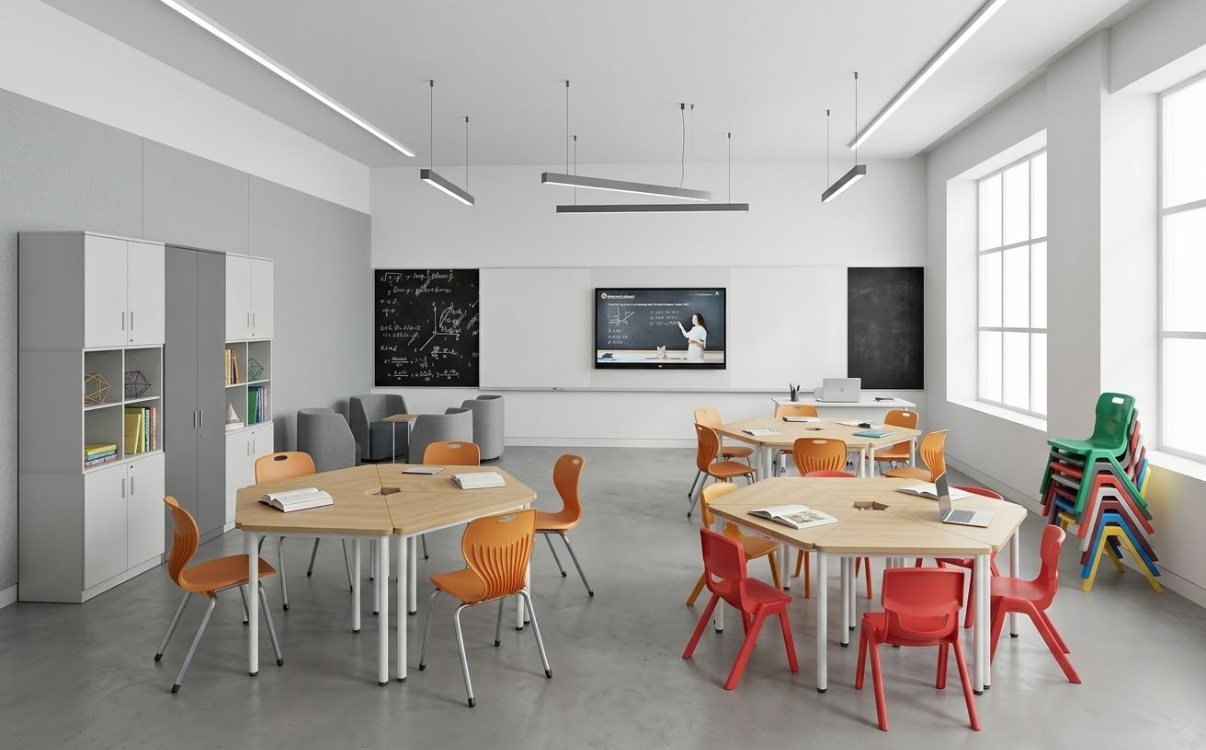
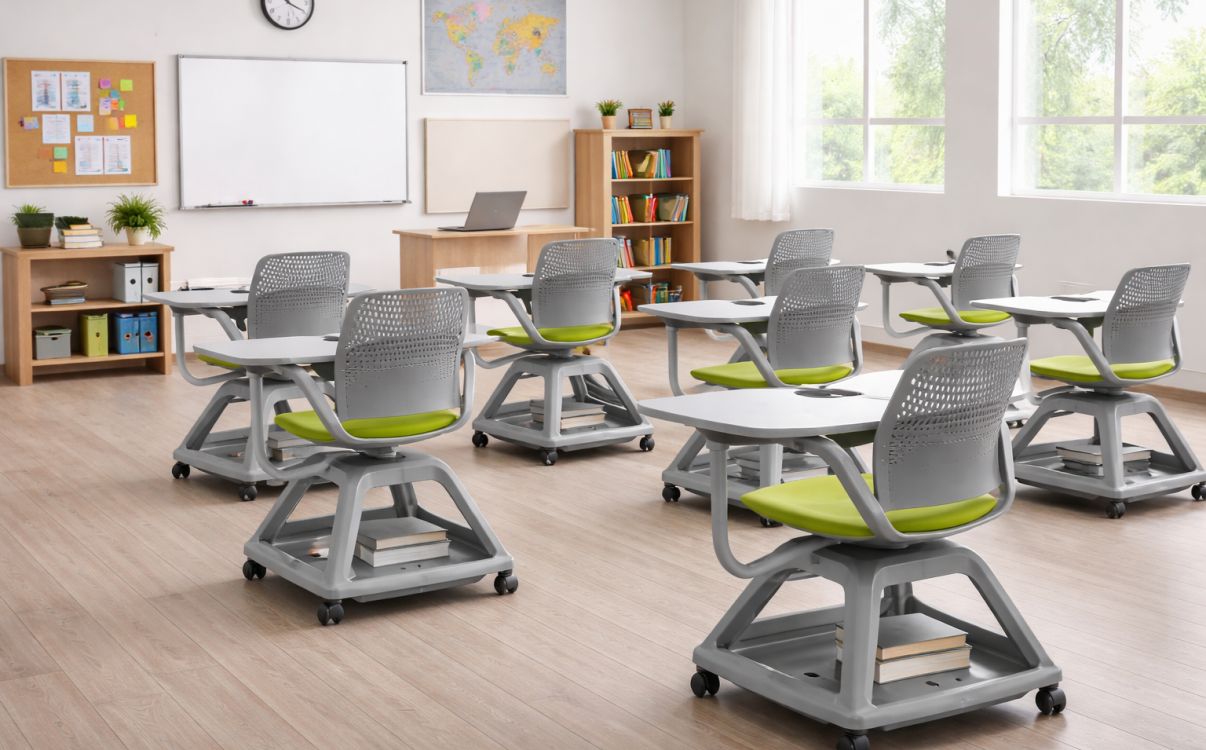
Explore bench desks for lecture halls, classrooms, and training centers. Learn about their structure, advantages, how to choose, and outstanding models at RPB Education & Public right below.

Kích thước ghế băng chờ inox, nhựa, nệm: Bảng thông số chi tiết nhất
Cập nhật bảng kích thước ghế băng chờ inox, nhựa, nệm theo 2–5 chỗ ngồi; kèm cách bố trí lối đi, chọn thông số phù hợp từng không gian như bệnh viện, trường học, văn phòng, bến xe.

What is a Stool? Classification, Uses and Standard Sizes
Learn what a stool is, popular types of stools, practical uses, standard sizes, and how to choose the right stool for your home, school, restaurant, and office.

Office Relocation Announcement – Elevating Your Experience
To enhance service quality, expand our workspace, and provide a better experience for our customers, we are pleased to announce the relocation of our office to a new address.

Announcement of product price adjustment
RPB Education & Public sincerely thanks our valued customers for your continued trust and partnership over the past years.
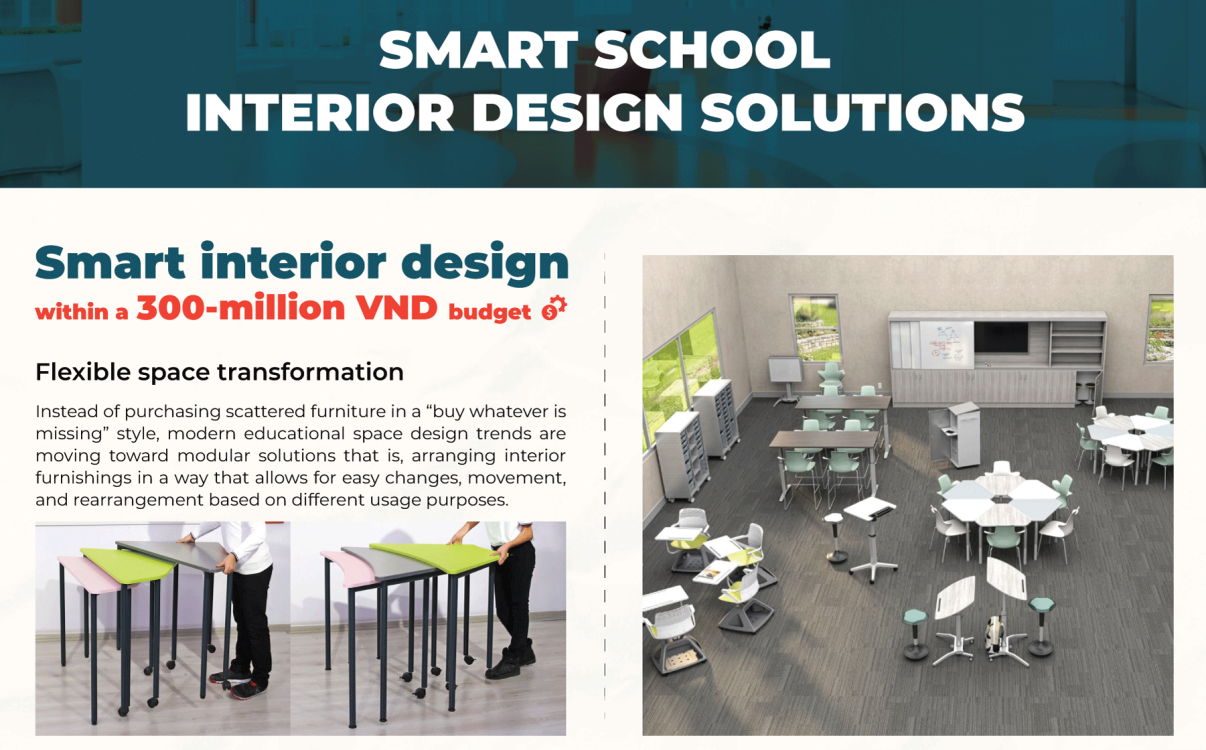
Smart Interior Design Solutions for Universities: Within a 300 Million VND Budget
Smart university interior design within a 300-million budget is not only a financial challenge but also a strategy to elevate the learning experience. With the right investment, it helps create modern, inspiring, and flexible spaces aligned with new teaching methods while optimizing long-term operating costs.

Environmental permit announcement
RPB Education & Public officially announces its environmental permit in accordance with current regulations, reaffirming the company's commitment to legal compliance, environmental protection, and sustainable development. This is an important step to ensure that all of RPB’s business and production activities are aligned with the goal of being environmentally friendly, safe for the community, and contributing to a greener future for the next generation.