


What is the standard distance between student desks and chairs?
The distance between student desks and chairs is one of the important factors when arranging classroom space. A desk and chair set with beautiful dimensions is not enough; they also need to be arranged at the correct distance so that students can sit comfortably, maintain standard study posture, and minimize spinal, visual, or neck and shoulder pain issues.
In modern educational environments, student desks and chairs not only serve the need to sit and study and write but also directly affect health, concentration ability, and knowledge absorption efficiency. Therefore, determining what the standard distance between student desks and chairs should be is an issue that schools, classroom design units, and parents need to pay special attention to.
The importance of arranging student desks and chairs to standard
Student desks and chairs are a group of furniture used continuously for long periods. On average, students can sit and study for many hours each day in class. If desks and chairs are arranged at the wrong distance, students are prone to bending over, hunching their shoulders, curling their legs, or sitting in improper posture.
Arranging student desks and chairs to standard helps create a safer, more scientific, and friendlier learning environment. This is also an important factor in modern school interior design, especially for educational levels such as preschool, elementary, secondary, and high school.
Affects study posture
The distance between student desks and chairs directly determines sitting posture. When the chair is placed too far from the desk, students tend to lean forward to write. Conversely, if the chair is placed too close to the desk, the upper body is compressed, arms find it difficult to rest comfortably on the tabletop, and legs do not have enough space to move.
An appropriate distance will help students sit with a straight back, relaxed shoulders, elbows resting naturally on the tabletop, and both feet touching the floor stably. This is the foundational posture to reduce back and neck strain and create comfort throughout the learning process.
Affects the spine and vision
Desks and chairs arranged at the wrong distance can cause students to form improper sitting habits over time. Bending the head too low, hunching the back, tilting shoulders, or leaning while writing can increase the risk of kyphosis, scoliosis, and neck and shoulder pain.
In addition, inappropriate desk and chair distance also affects vision. When students have to bend close to books and notebooks, the distance from the eyes to the tabletop is shortened, causing the eyes to have to adjust more. In the long run, this can contribute to increased eye strain, reduced concentration ability, and affect study habits.
Affects the ability to concentrate on studying
A comfortable seat helps students maintain concentration more easily. When the distance between the desk and chair is reasonable, students have to change posture less frequently, do not get their legs stuck, are not compressed in the abdomen, and can perform writing, reading, and homework tasks more conveniently.
Conversely, if the desk and chair are too cramped, too high, or too low, students are easily distracted due to feelings of discomfort during study time. Therefore, arranging desks and chairs to standard is not only an aesthetic or technical issue but also relates to the quality of the learning experience in the classroom.
Why is it necessary to ensure the standard desk and chair distance for students?
Standard desk and chair distance brings many practical benefits to students and schools. This is a small factor in classroom design but has a significant impact on student health.
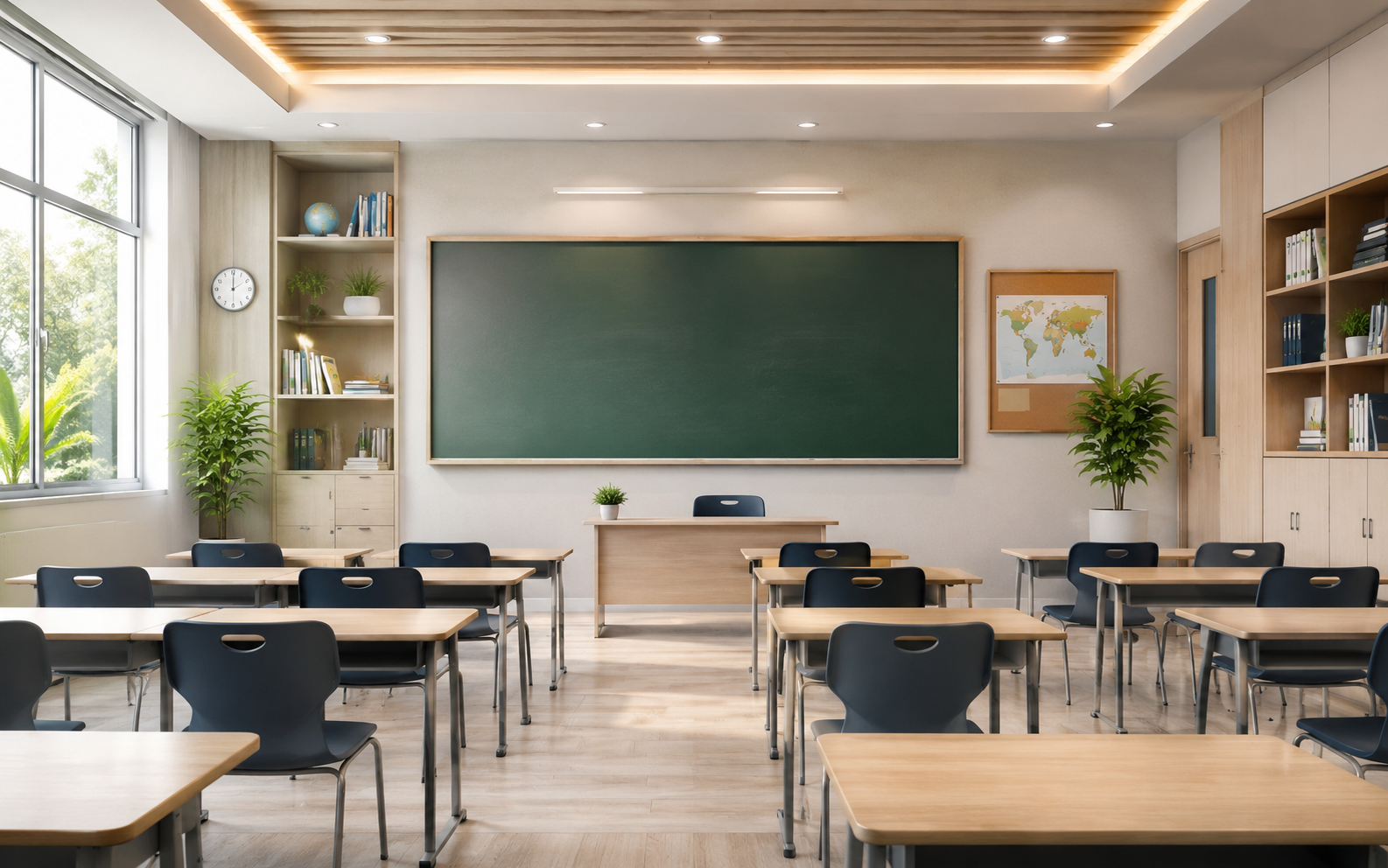
Supports correct sitting posture
Correct sitting posture is generally understood as a straight back, head slightly and naturally bent, balanced shoulders, feet comfortably placed on the floor, and arms resting at the right height on the tabletop. To achieve this posture, the desk height, chair height, and the distance between the desk and chair must be compatible with the student's body height.
When the distance is appropriate, students can sit close enough to the desk to write but without feeling constrained. The back can still lean or remain naturally straight without having to lean forward.
Keeps the back straight, limits bending the head too low
One common mistake when arranging student desks and chairs is that the desk is too low or the chair is too far from the desk. This forces students to bend their heads low to see their notebooks and write clearly. If this condition persists, the neck, shoulders, and upper back are prone to strain and fatigue.
The standard distance between student desks and chairs helps keep the upper body in a more balanced position. Students can look down at books and notebooks at a reasonable distance without having to bend over or tilt their heads excessively.
Limits scoliosis
Scoliosis in students is often related to many factors such as sitting posture, heavy backpack habits, prolonged study time, and unsuitable desk and chair conditions. Among these, desks and chairs of incorrect size or improper distance are common causes in classrooms.
When desks and chairs are arranged correctly, students have better conditions to maintain a balanced sitting posture. This helps reduce uneven pressure on the spine, limiting the habit of leaning, tilting shoulders, or sitting crookedly while studying.
Reduces the risk of kyphosis and neck and shoulder pain
A desk and chair distance that is too far causes students to lean forward. A distance that is too close compresses the shoulders and arms, making natural movement difficult. Both cases can increase pressure on the neck, shoulders, and back.
A reasonable distance allows the shoulders to relax, elbows to rest comfortably, and the back to remain straighter. As a result, students can study longer with less pain and fatigue.
Protects students' vision
Appropriate desk and chair distance helps maintain a reasonable distance from the eyes to books and notebooks. Typically, when studying, the eyes should be about 25 - 30cm away from the notebook surface depending on the student's age and physical condition. If the desk and chair distance is incorrect, students tend to bend close to their notebooks, causing their eyes to adjust continuously.
Arranging desks and chairs to standard, combined with appropriate classroom lighting, will help protect vision better, especially for elementary school students - an age group that is forming study habits and sitting posture.
Increases concentration and learning effectiveness
When the body is comfortable, students are less distracted by feelings of pain, fatigue, or discomfort. Standard desk and chair distance helps students write, read, discuss in groups, and participate in other learning activities more easily.
This is why modern schools are increasingly paying attention to choosing desks and chairs of the correct size, suitable for age groups, and easy to arrange flexibly in the classroom space.
What is the standard distance between student desks and chairs?
To determine the standard distance between student desks and chairs, it is necessary to clearly understand two main factors: the horizontal distance between the desk edge and the chair edge, and the height difference between the seat surface and the desk surface.
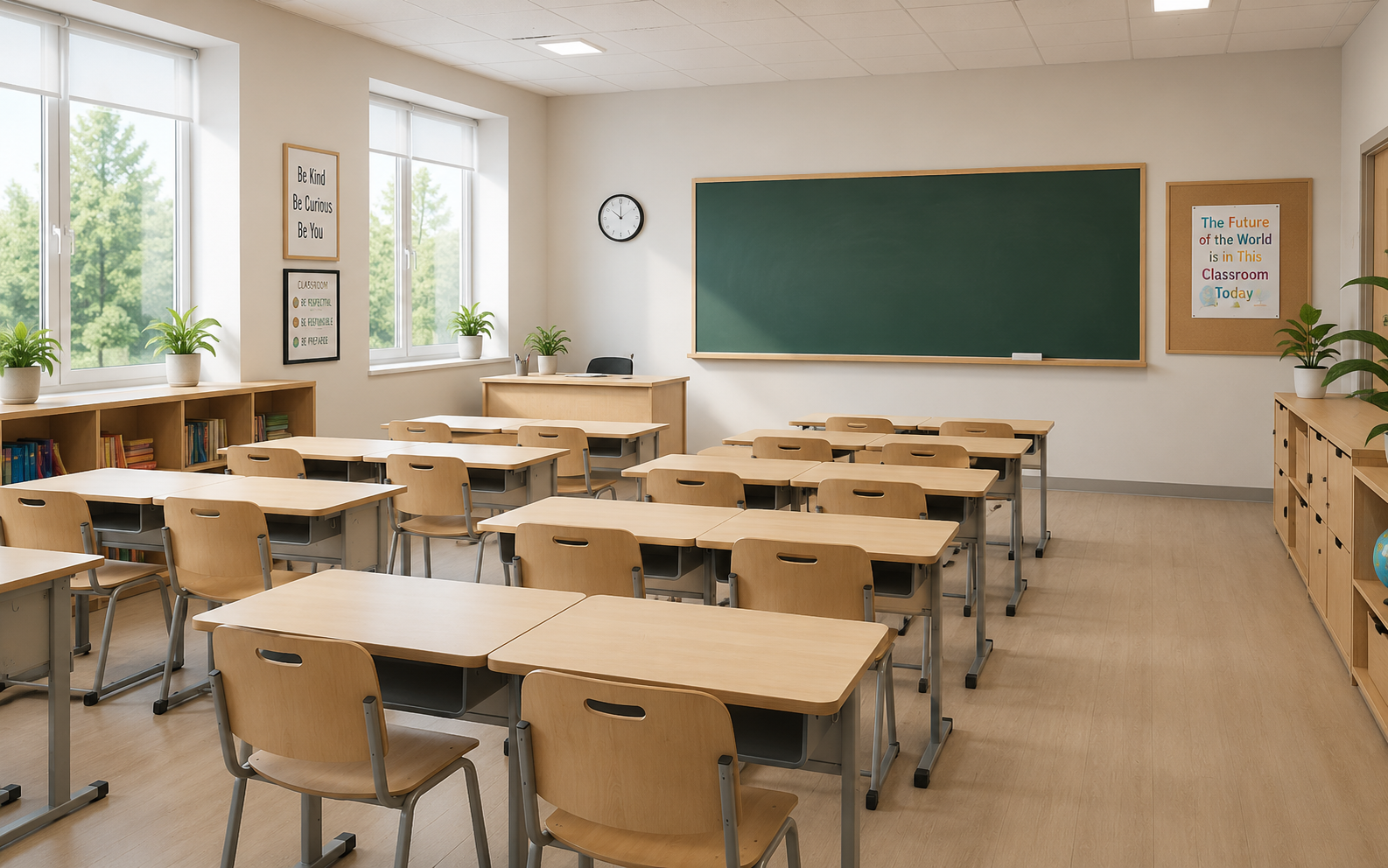
Concept of the distance between student desks and chairs
The distance between student desks and chairs is not just the visible gap between the two pieces of furniture. In terms of ergonomics, this distance includes both the horizontal distance and the height difference.
The horizontal distance between the chair edge and the desk edge is the distance from the front edge of the chair to the back edge of the desk. This is the distance that determines whether a student sits close to or far from the desk.
The height difference between the seat surface and the desk surface is the vertical difference from the seating surface of the chair to the desktop. This parameter directly affects the arm position, shoulder opening, back curvature, and comfort when writing.
Standard distance according to regulations
According to standards commonly applied in the design of student desks and chairs in Vietnam, desks and chairs should be selected based on the student's height group. Each height group corresponds to different desk heights, chair heights, and height differences between the desktop and seat surface, in order to ensure that students can sit and study comfortably, keep their backs straight, and place their arms in the correct posture.
Specifically, for students with a height of 100 - 109cm, the reference chair height is about 26cm, desk height about 45cm, and the height difference between the desktop and seat surface about 19cm. For students with a height of 110 - 119cm, the appropriate chair height is about 28cm, desk height about 48cm, and the height difference between the desktop and seat surface about 20cm.
For students with a height of 120 - 129cm, the chair should be about 30cm high, the desk about 51cm high, creating a height difference of about 21cm. For the height group of 130 - 144cm, the reference chair height is about 34cm, desk height about 57cm, and the height difference between the desktop and seat surface about 23cm.
For students with a height of 145 - 159cm, the appropriate chair height is about 37cm, desk height about 63cm, and the height difference about 26cm. For students with a height of 160 - 175cm, the chair height should be about 41cm, desk height about 69cm, and the height difference between the desktop and seat surface about 28cm.
These parameters can be used as a reference basis when selecting student desks and chairs for each educational level. However, in practice, schools should still combine factors such as sitting posture, legroom space, and comfort when students use them to ensure the most appropriate desk and chair arrangement.
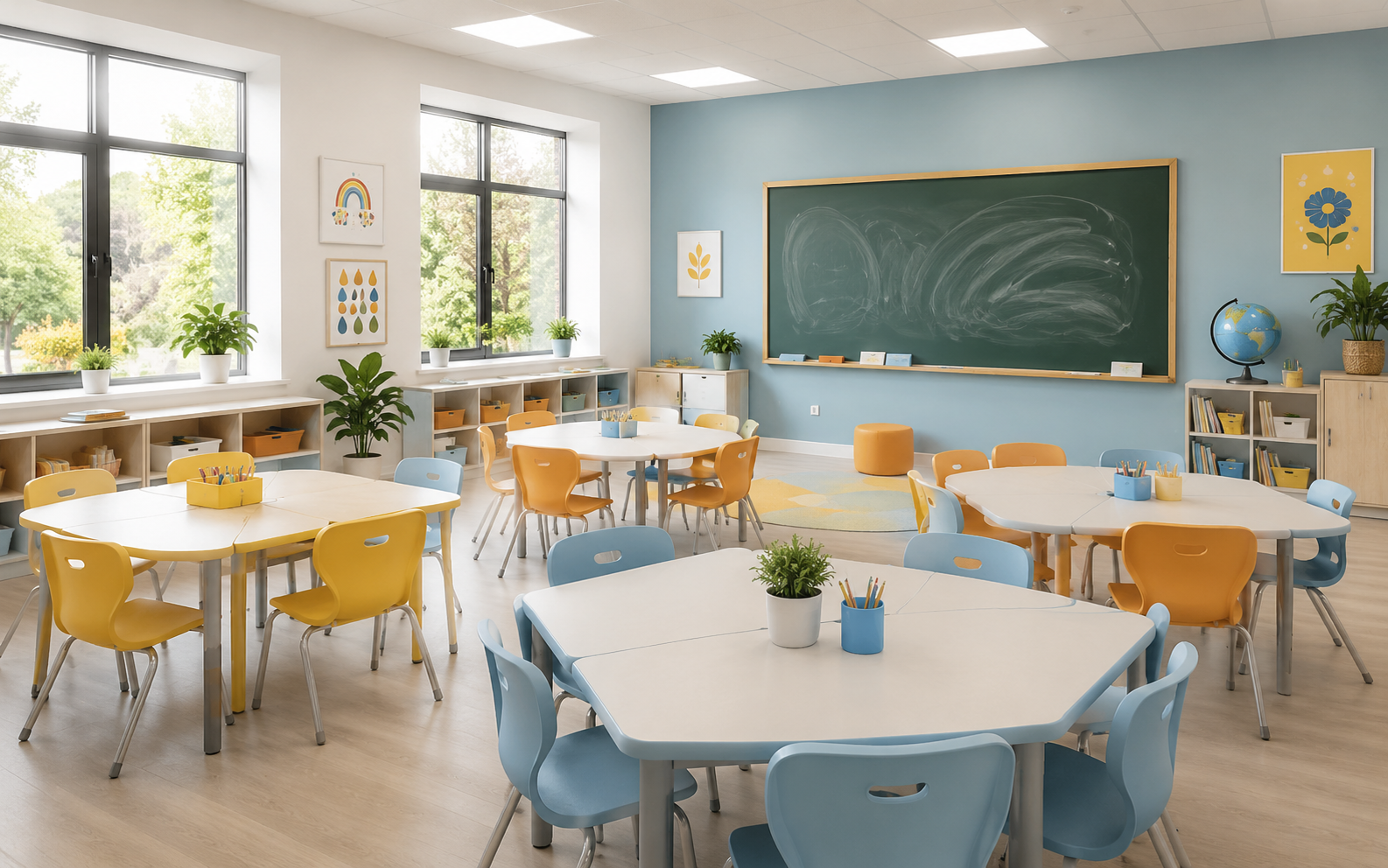
Common reference parameters
In actual classroom arrangement practice, schools can refer to the following groups of parameters:
-
The height difference between the desktop and seat surface usually ranges from about 19 - 28cm depending on student height.
-
Legroom needs to be wide enough for students to stretch and bend naturally, without being obstructed by desk drawers, crossbars, or desk legs.
-
The distance from the eyes to the notebook should be maintained at about 25 - 30cm when students are sitting and writing.
-
The desk edge should be at a position that allows students to place their forearms comfortably without needing to hunch their shoulders.
These parameters need to be adjusted according to educational level, average student height, and the design characteristics of each type of desk and chair.
Appropriate distance according to age group
For preschool students, desks and chairs need to be low in size, with rounded safety corners, moderate weight, and a close enough distance for children to operate easily. However, the chair should not be placed too close to the desk because children need space to get in and out, turn around, and participate in fun learning activities.
For elementary school students, the desk and chair distance needs to support correct writing posture. This is the stage when students form habits of holding pens, writing, and reading, so desk and chair heights must be suitable for their body size.
For secondary school students, body height changes rapidly, so desks and chairs need to have appropriate sizes or use more flexible models. The desk and chair distance must ensure enough legroom and long-term sitting posture.
For high school students, desks and chairs need to be larger, with a desktop wide enough to hold books, materials, and learning devices. The chair needs to be sturdy, provide good support, and create comfort when students sit for long periods.
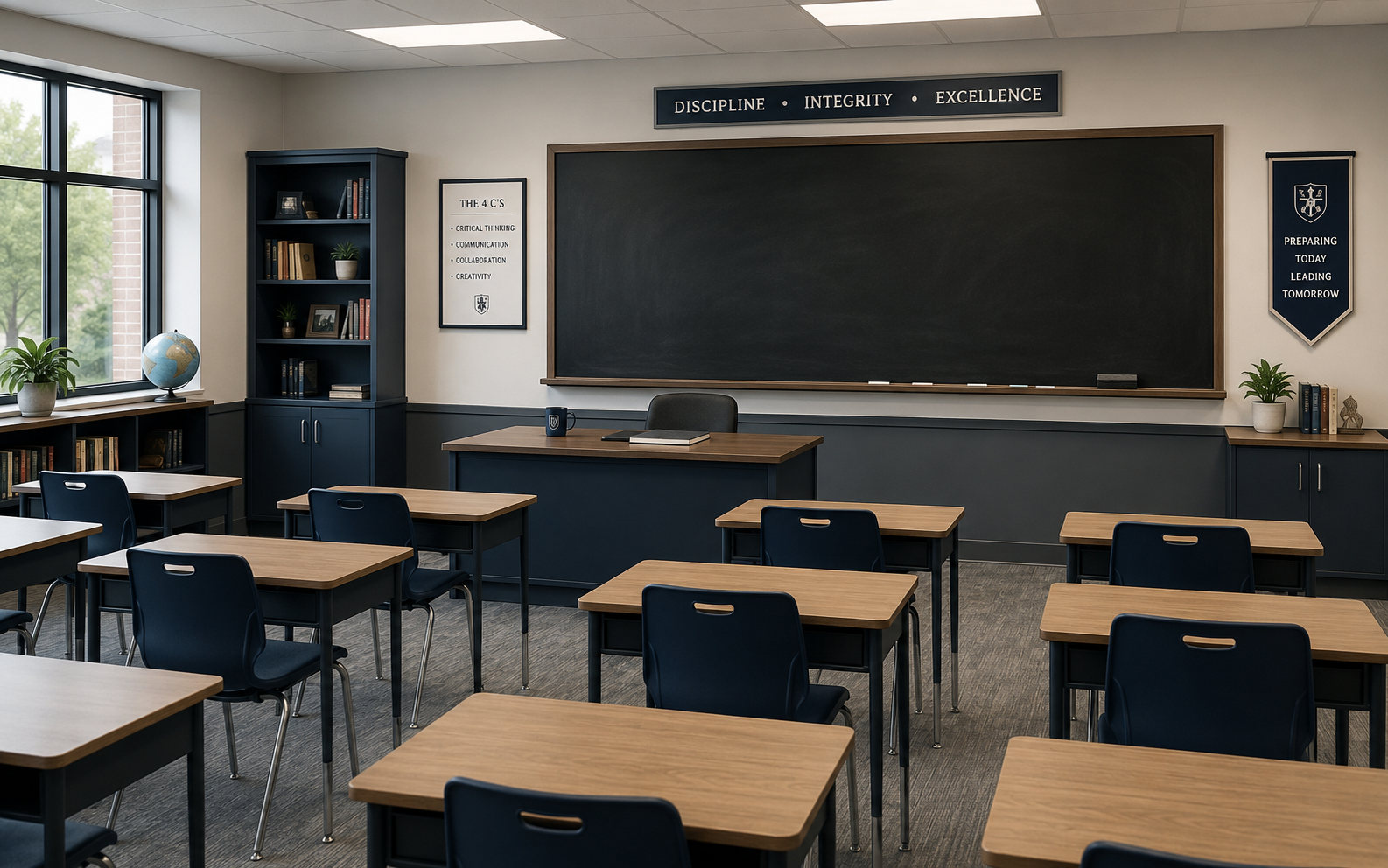
How to determine the appropriate distance between student desks and chairs
One should not choose student desks and chairs based on intuition or a fixed size for all ages. A more accurate method is based on student height, standard sitting posture, and the actual conditions of the classroom.
Based on student height
Student height is the most important basis for determining appropriate desk and chair sizes and usage distance. In a classroom with students of the same age but with large height differences, schools should consider using multiple desk and chair sizes or height-adjustable desks and chairs.
When choosing desks and chairs, it is necessary to ensure that when students sit on the chair, both feet can touch the floor, knees bend naturally, back stays straight, and arms rest on the desk in a comfortable position. If the feet do not touch the floor or the knees are bent too high, that chair is not suitable.
Based on standard sitting posture
A desk and chair set with an appropriate distance needs to help students maintain the following sitting posture:
-
Naturally straight back, not hunched.
-
Balanced shoulders, not raised.
-
Forearms resting comfortably on the desktop.
-
Eyes about 25 - 30cm from books and notebooks.
-
Both feet placed stably on the floor.
-
Upper body not pressed tightly against the desk edge.
If a student has to pull the chair too far away to sit down or has to press close to the desk when writing, the desk and chair distance needs to be adjusted.
How to measure desk and chair distance correctly
To measure and check student desk and chair distance, the following steps can be taken:
First, have the student sit in the correct posture on the chair, with both feet placed naturally on the floor. Then, check the position of the desktop relative to the elbows. The desktop should be at a height that allows the student to place their arms comfortably, without having to raise their shoulders or bend over.
Next, check the horizontal distance between the chair edge and the desk edge. The student needs to have enough space to sit down, but still be able to easily reach the desktop when writing. If the student has to lean forward, the chair is too far. If the upper body is compressed, the chair is too close.
Finally, check the legroom under the desk. The student's legs should not be obstructed by desk drawers, crossbars, or desk edges. The more reasonable the legroom, the more comfortable the sitting posture.
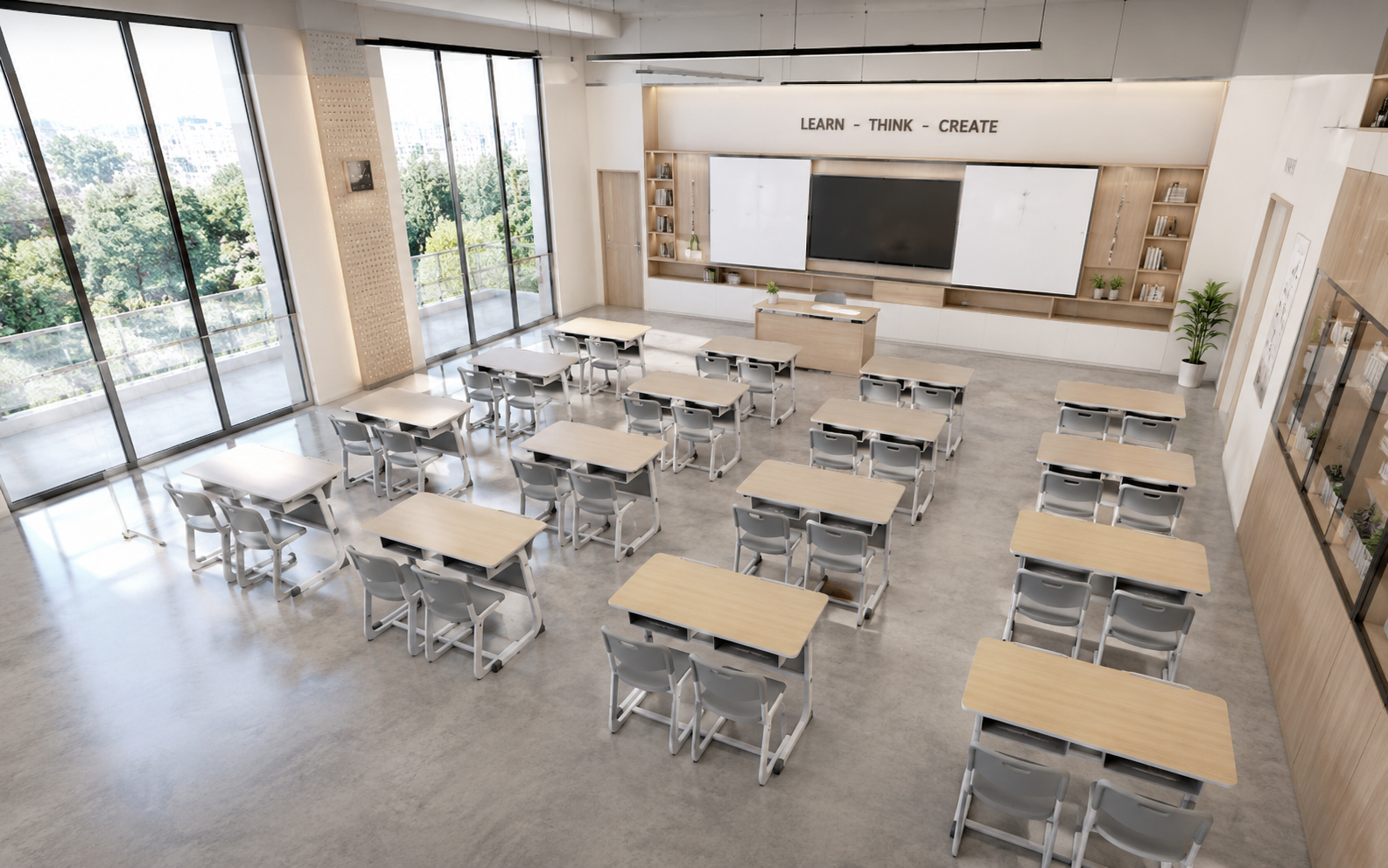
Standards for arranging desks and chairs in modern classrooms
In addition to the distance between student desks and chairs, the overall arrangement in the classroom is also very important. A modern classroom needs to ensure learning space, walkways, lighting, and flexibility in organizing activities.
Distance between rows of desks
The distance between rows of desks needs to be wide enough for students and teachers to move conveniently. Aisles that are too narrow can cause collisions, make observation difficult, and be inconvenient for group activities.
In modern classrooms, desks and chairs are not only arranged in traditional horizontal rows but can also be arranged in groups, U-shapes, or flexible modules. Therefore, desks and chairs need to have a compact design, be easy to move, and be suitable for various arrangement styles.
Movement space in the classroom
Movement space needs to be calculated so that teachers can easily approach each student and provide support during teaching. Students also need enough space to get in and out of their seats, take learning materials, and participate in class activities.
If desks and chairs are too bulky or arranged too close together, the classroom will become cramped, lacking flexibility, and affecting the learning experience.
Appropriate lighting and sitting angle
Student desks and chairs should be arranged in positions with appropriate lighting, avoiding glare, insufficient light, or backlighting. Good lighting helps students see books, notebooks, and the board clearly and reduces eye strain.
In addition, the sitting angle needs to ensure that students can easily observe the board, screen, or teaching area. Positions that are too skewed or too close to the board may cause students to turn their necks, lean their bodies, and affect sitting posture.
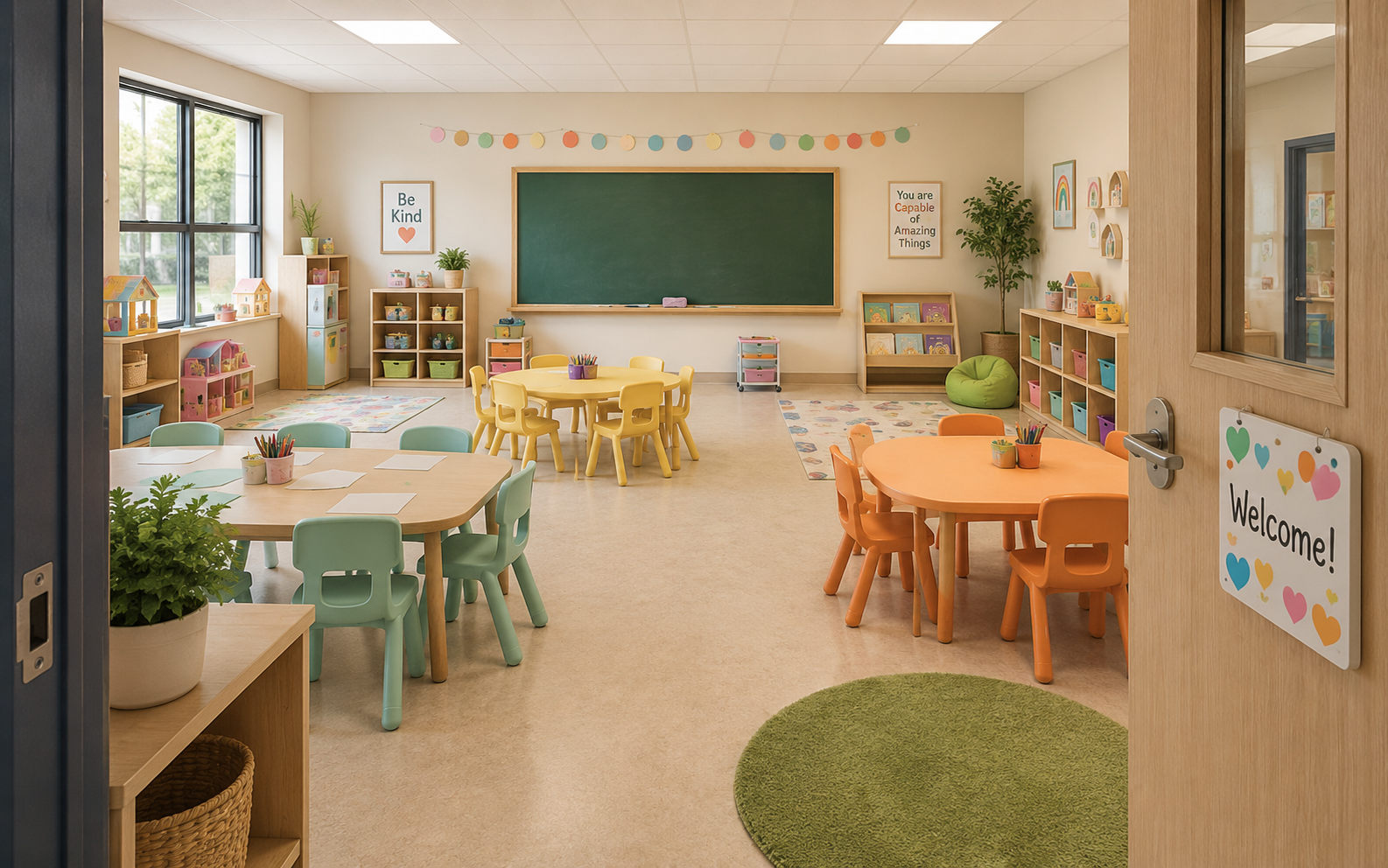
Common mistakes when arranging student desks and chairs
In practice, many classrooms still encounter desk and chair arrangement errors that make students uncomfortable. These mistakes need to be identified and adjusted early.
Desk too high relative to the chair
When the desk is too high, students have to raise their shoulders and arms when writing. This condition easily causes shoulder and neck fatigue and makes writing motions less natural. A desk that is too high also makes it difficult for students to maintain a comfortable posture for long periods.
Chair too low or too high
A chair that is too low forces students to reach up to the desk, while a chair that is too high prevents the feet from touching the floor or causes the knees to bend unnaturally. Both cases affect sitting posture and body stability.
Desk and chair distance too close
A chair placed too close to the desk compresses the upper body, making it hard to turn and difficult to place the arms comfortably. This is especially inconvenient for older students or in classes with long study sessions.
Using desks and chairs that do not fit student height
Another mistake is using the same desk and chair size for many groups of students with different heights. Meanwhile, students at different educational levels have very different physical development. Choosing the wrong size may make the desks and chairs look beautiful but ineffective in use.
Suggestions for standard student desk and chair models currently available
To ensure the standard distance between student desks and chairs, the key factor for protecting vision and the spine, schools need to prioritize choosing desk and chair lines specifically designed for each educational level. A standard desk and chair set not only needs appropriate dimensions for body size, safe and durable materials, but also must be easy to arrange and optimize classroom space.
Elementary school desks and chairs
The elementary school stage is when children's skeletal system is still forming, so desks and chairs must strictly comply with medical standards regarding dimensions to support correct sitting posture and avoid the risk of kyphosis and scoliosis.
In particular, safety must be the top priority: desk and chair edges must be carefully rounded to avoid injury when active children run and play. The desktop needs to have sufficient area for books, pencil cases, and the surface should preferably have an anti-glare coating to protect eyes. The chair must have a sturdy backrest with an appropriate inclination, and the materials (plastic, wood, electrostatic powder-coated steel) must be easy to clean, health-friendly, and have bright colors to stimulate learning interest.
To meet the strict standards for the elementary school environment, RPB Education & Public offers optimal solutions with the Hico desk model, featuring a compact design, absolutely safe rounded edges, and a sturdy leg frame structure.
View details at: Hico preschool desk
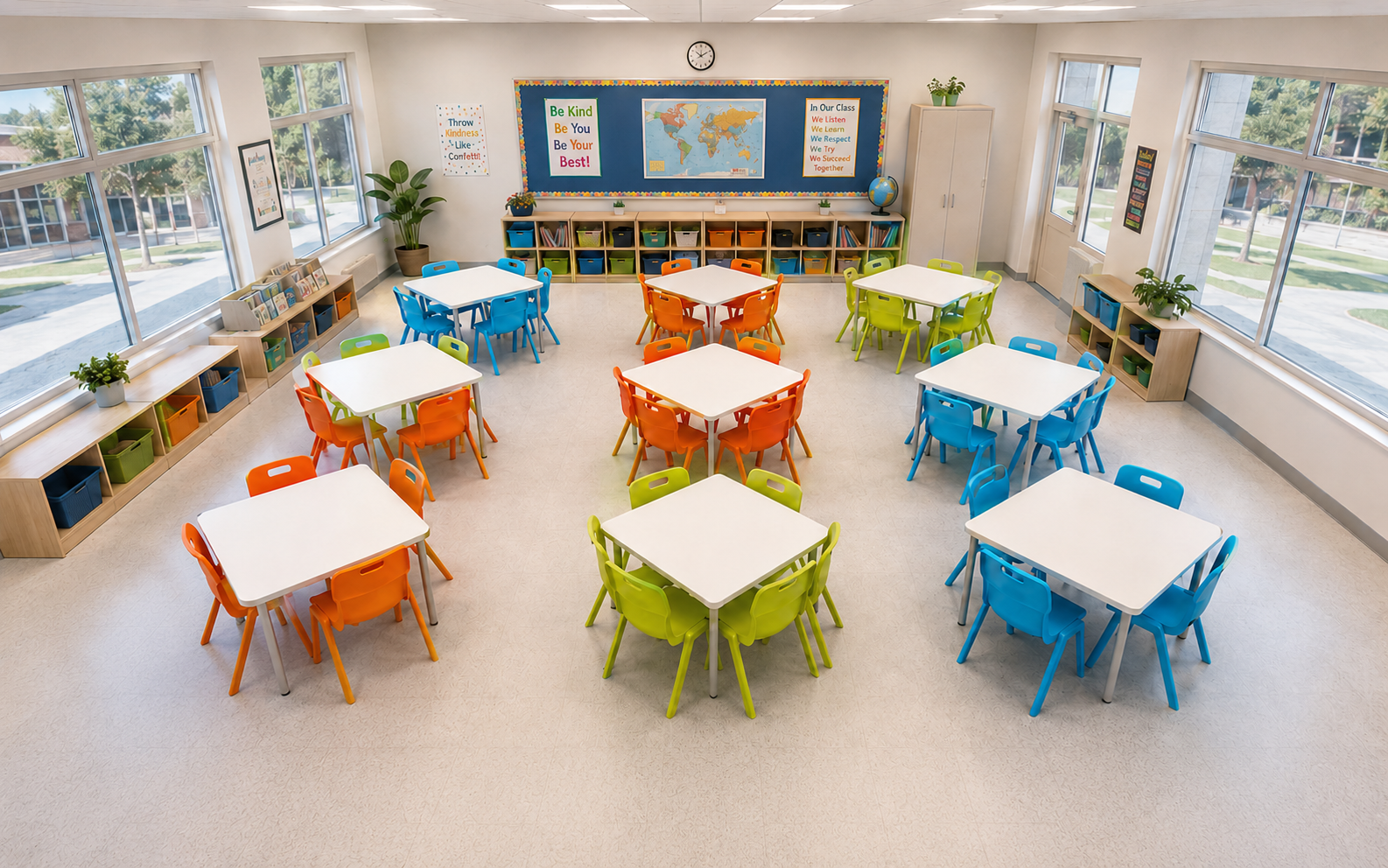
At RPB Education & Public, there is the Titan virgin plastic chair, molded from high-quality virgin plastic, containing no toxic substances. The chair form is designed to hug the body, providing maximum comfort for students throughout class periods.
View details at: Titan virgin plastic chair
Secondary and high school desks and chairs
Entering the secondary level, students' physical build develops strongly and diversely in height and weight. Along with that, the volume of books and learning devices (such as laptops and tablets) also increases significantly. Therefore, desks and chairs for this age require an extremely sturdy frame structure, high load-bearing capacity, and welded joints and screws need to be reinforced to prevent wobbling.
In terms of design, teenagers often prefer a minimalist, elegant, modern, and more mature style. The chair must have a physiological curvature design for the back to reduce pressure on the spinal discs, a wide seat surface, and create comfort during intense, prolonged study periods.
The secondary school desk and chair product lines at RPB Education & Public are a perfect combination of durability and high aesthetics:
Zico desk: Elegant design, standard school steel frame structure, scratch-resistant and easy-to-clean desktop.
View details at: Zico 01 - S school desk
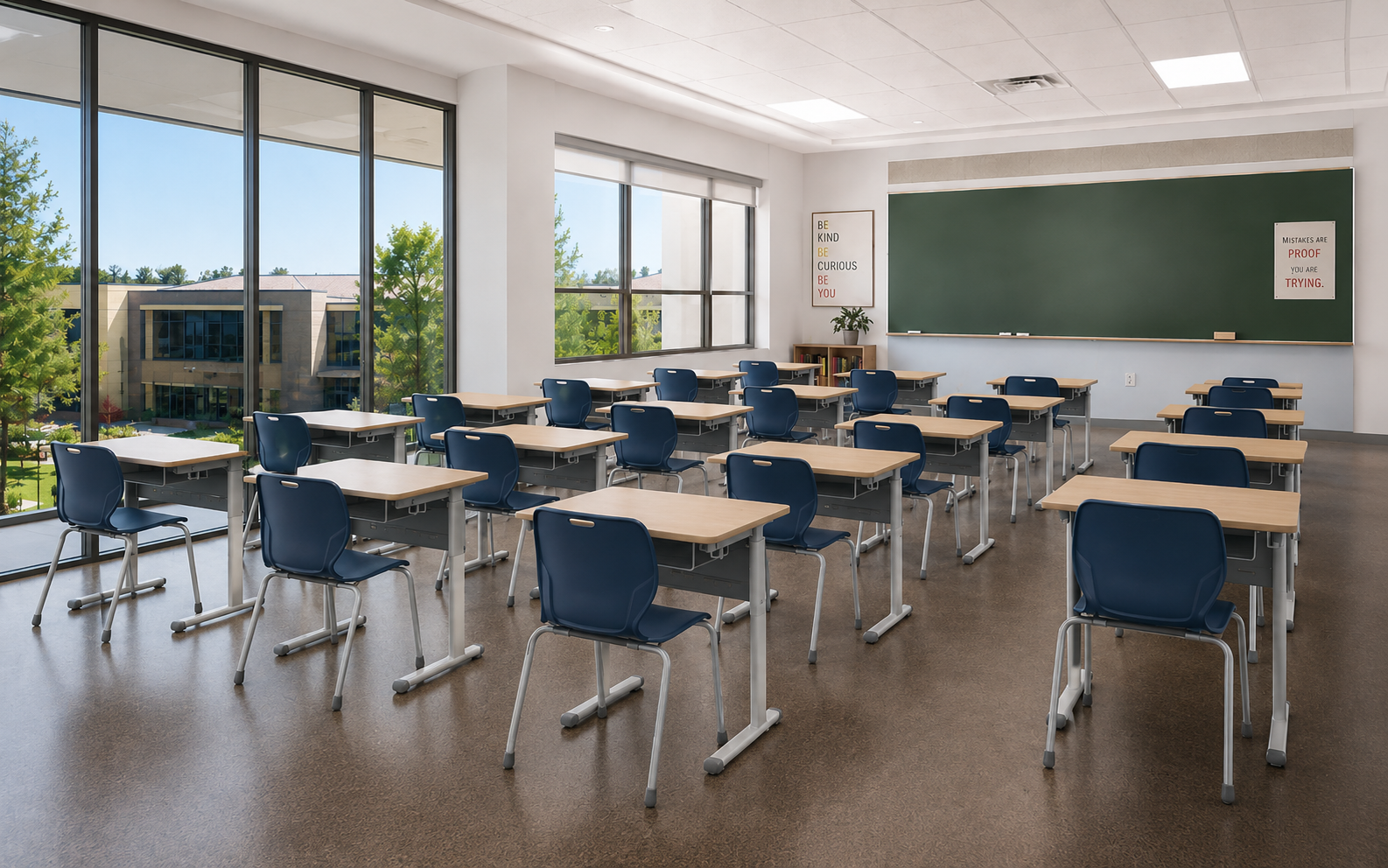
Eco desk: Focuses on minimalism and high applicability, saving space while still ensuring a spacious learning area.
View details at: Eco 01 school desk
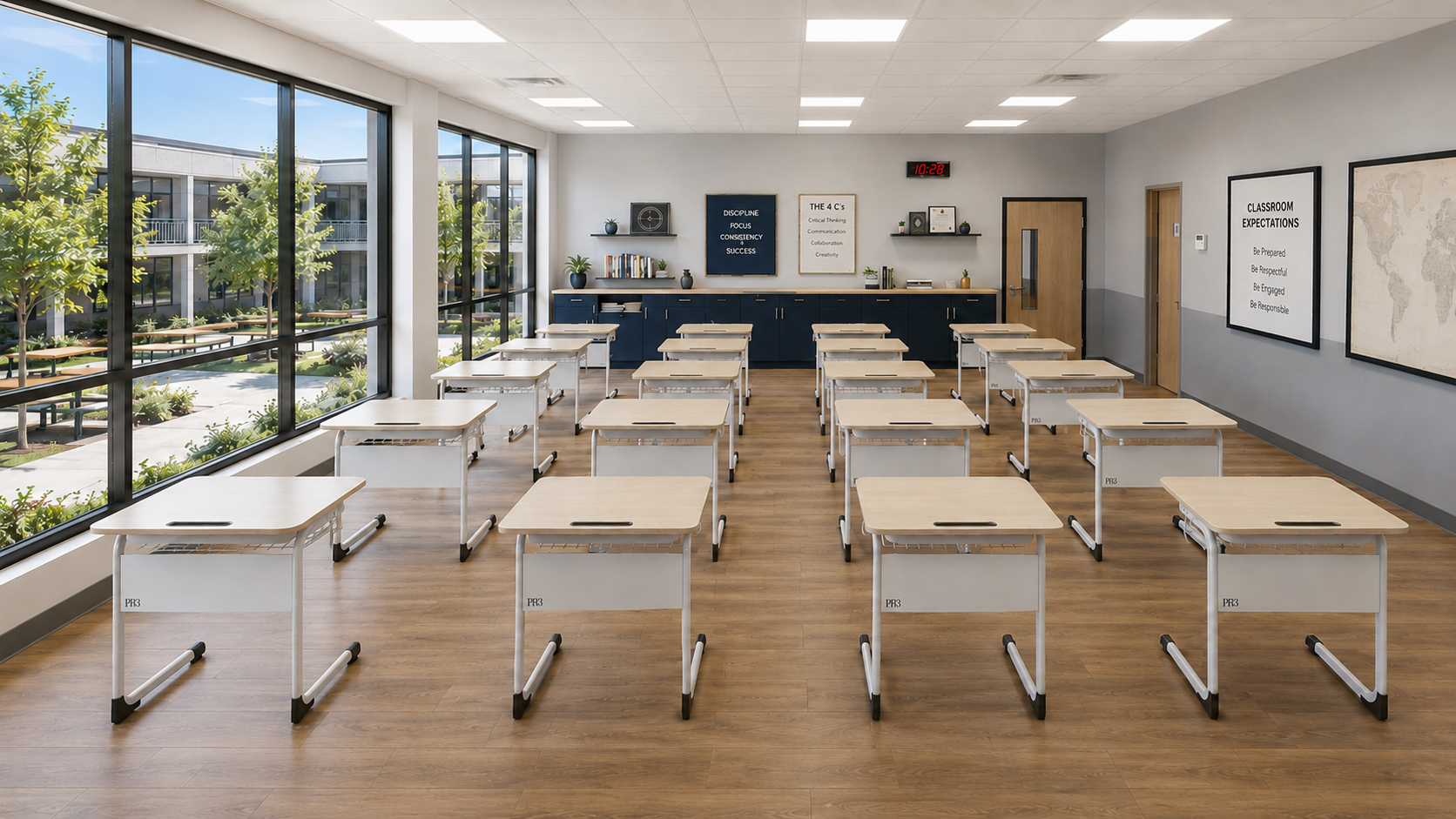
Moto chair: Plastic backrest designed to curve and hug the sitter's back, providing high breathability and effective fatigue prevention.
View details at: Moto plastic back chair 02
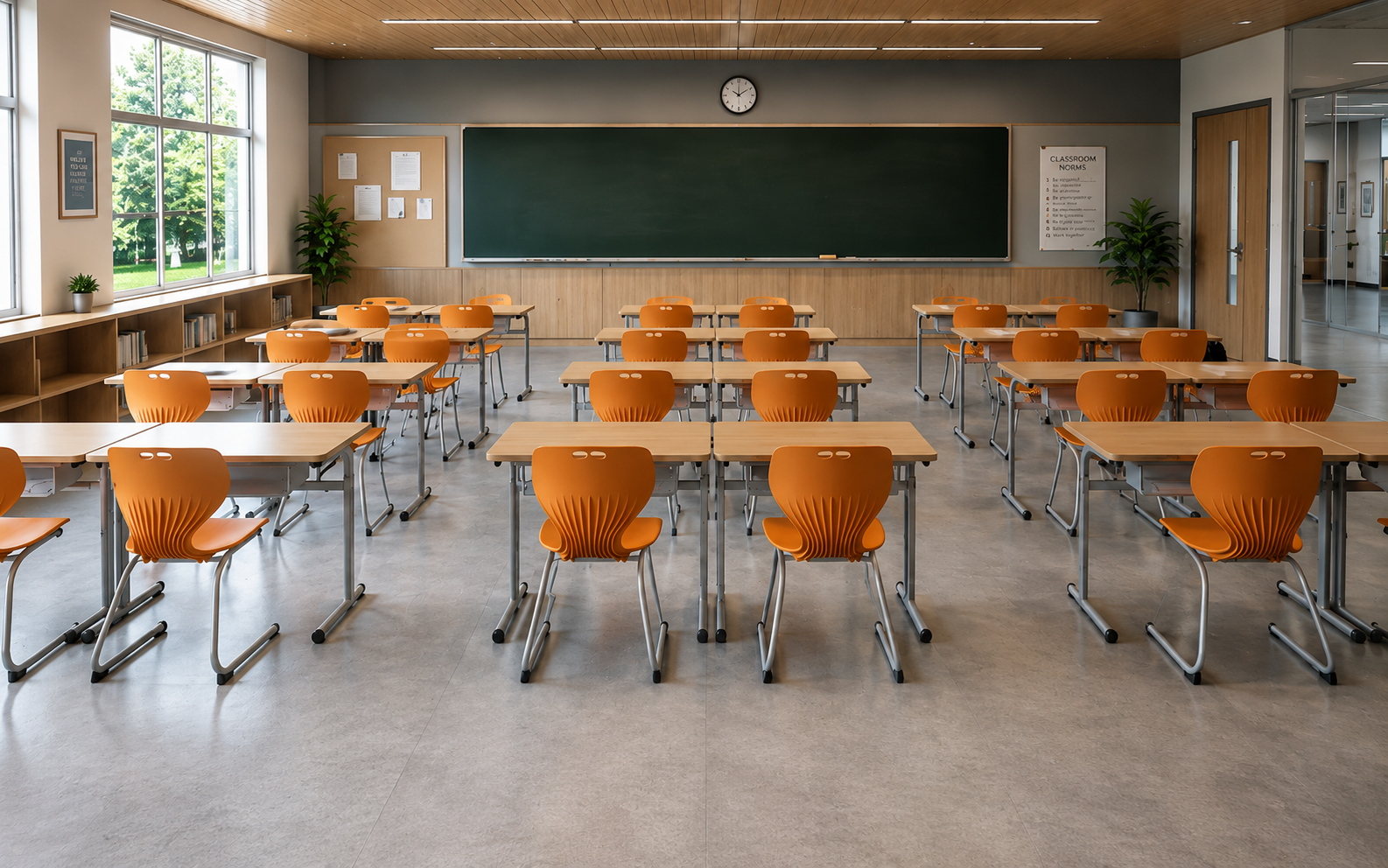
ARC chair: Extremely durable with a 4-leg design incorporating a reinforced support bar, ensuring absolute stability against all impacts.
View details at: ARC 4-leg chair with reinforcement bar
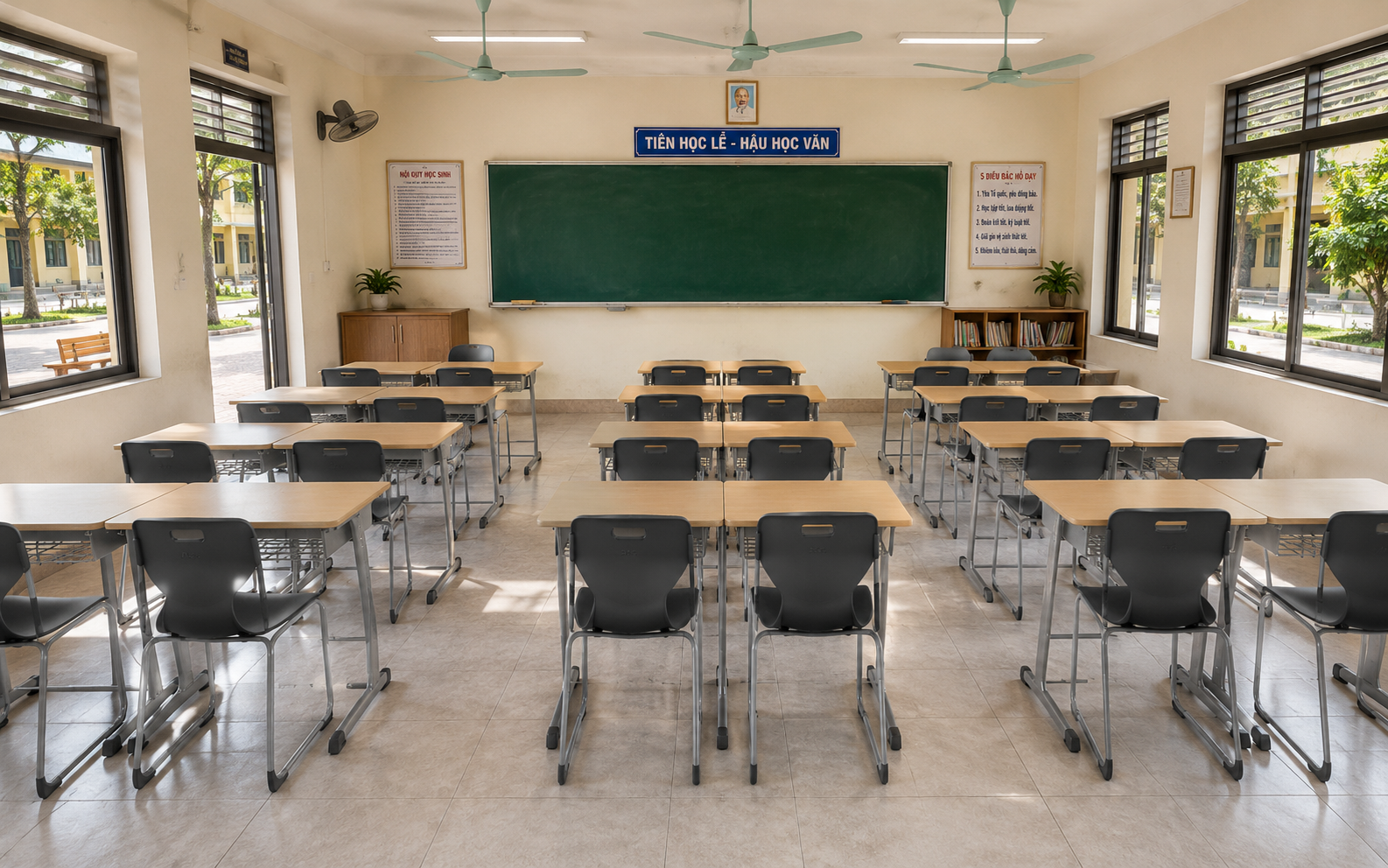
Smart height-adjustable desks and chairs
Students' physical development is continuous, causing fixed desk and chair sets to quickly become cramped and posture-incorrect. Smart desks and chairs with height-adjustable lifting/lowering capabilities are a breakthrough long-term investment solution.
This product line allows flexible adjustment of both the desktop and seat surface heights, helping children's feet always rest firmly on the floor, with thighs and calves forming a standard ergonomic right angle. Furthermore, some desk models also allow adjustment of the working surface inclination (from 0 - 60 degrees) to optimize the viewing angle for different activities: writing, reading, or drawing, contributing to maximum prevention of school-related conditions such as myopia and kyphosis.
Thanks to modern manufacturing technology that is safe for users, RPB Education & Public offers lift-adjustable desk and chair solutions with smooth operation and easy handling:
New version smart lift desk, with gentle height adjustment, anti-glare desktop, and ergonomic design.
View details at: Smart Zico lift desk
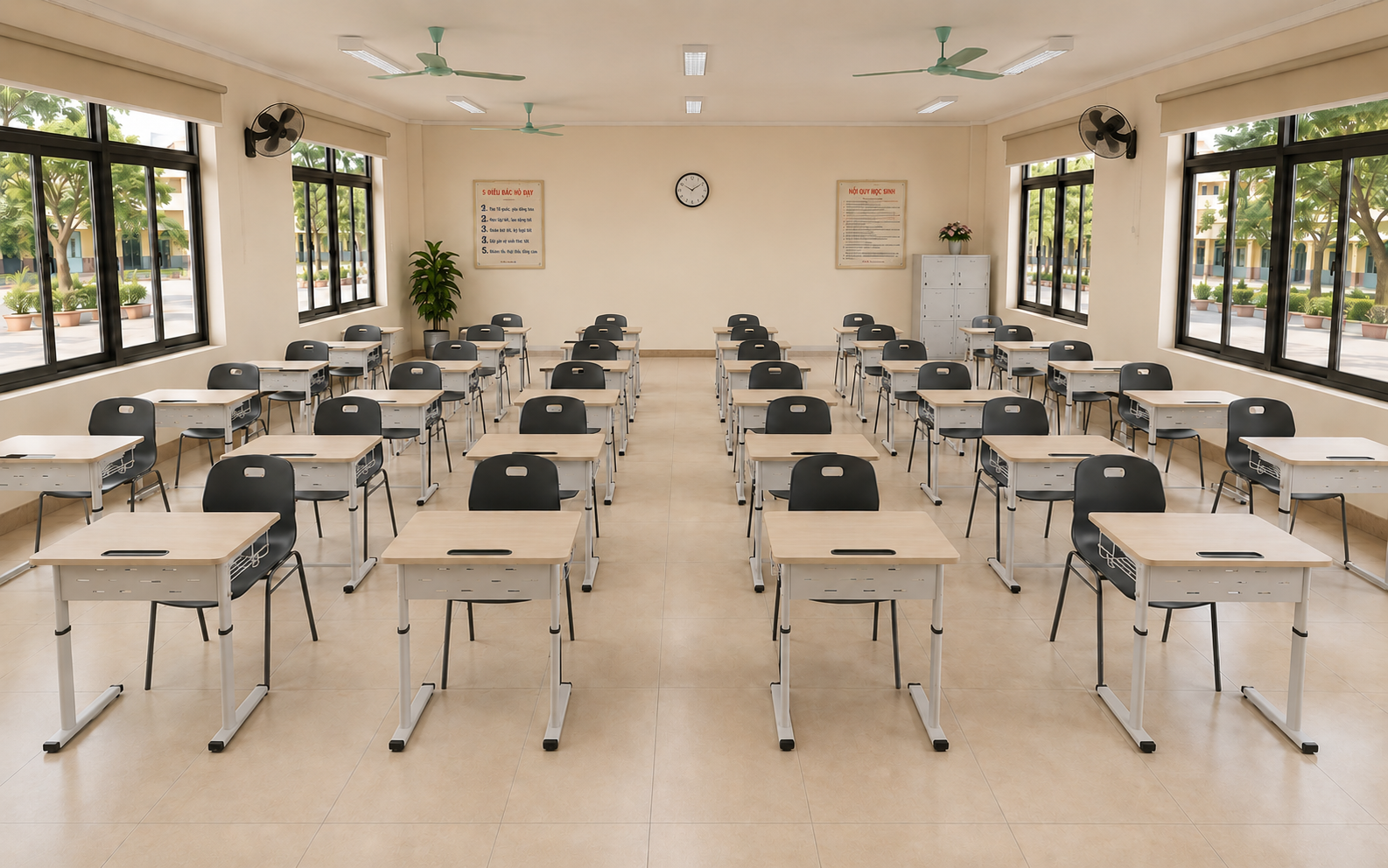
A powerful companion to the lift desk, the Moto lift chair features a backrest and seat cushion that hug closely, with curved design that excellently distributes pressure, providing complete spinal support at all ages.
View details at: Moto lift chair
Desks and chairs for modern classrooms
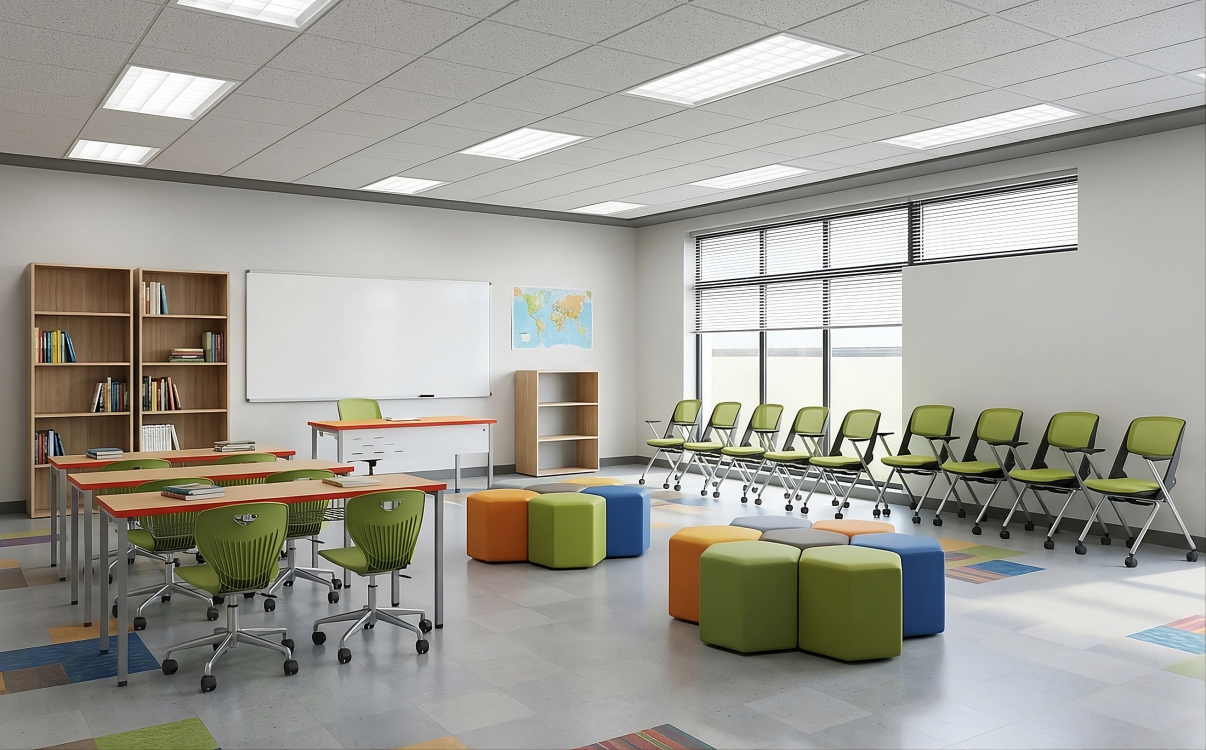
In today's advanced educational methods such as STEM models and project-based learning, classroom space is no longer confined to fixed straight rows of desks. Instead, the learning environment demands high flexibility, encouraging interaction and teamwork.
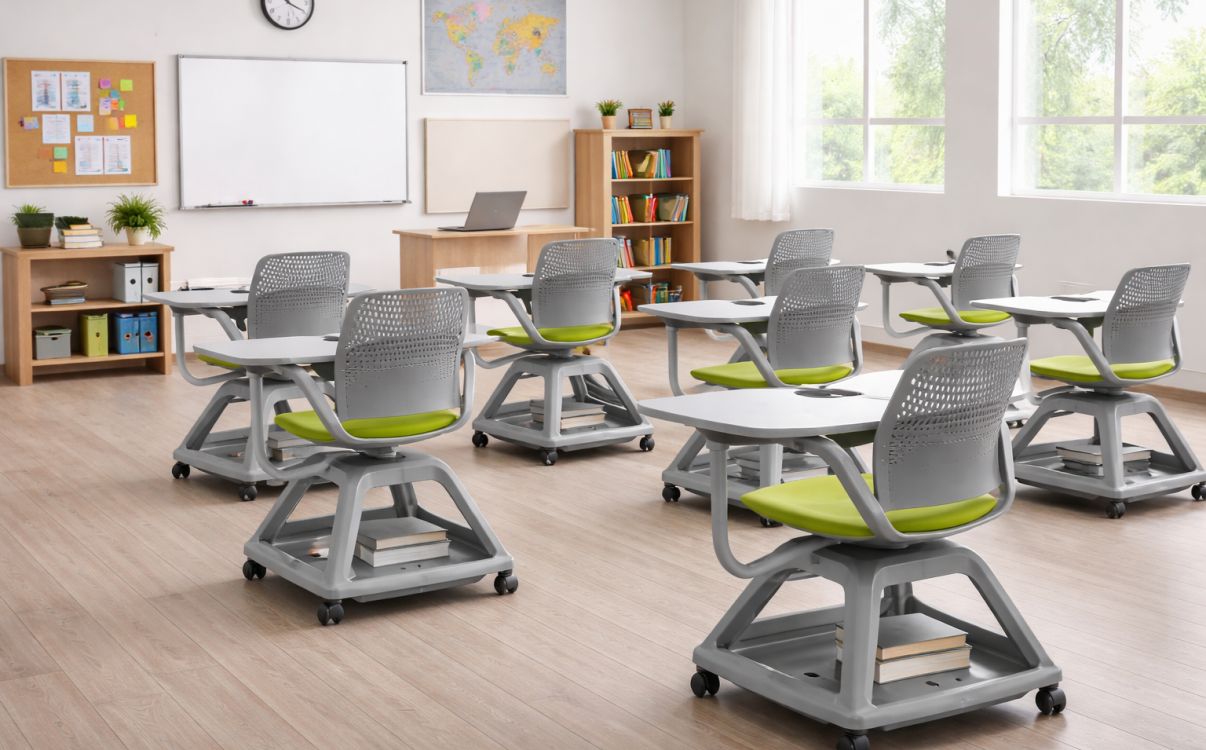
Desks and chairs designed for modern classrooms often feature unique shapes such as trapezoidal or hexagonal desktops, easy to move and connect into clusters, small groups, or large discussion circles. Product weight is usually optimized so that students can arrange them themselves. Chairs often have convenient designs, stackable to quickly free up classroom space when organizing extracurricular activities.
Keeping pace with the trend of building smart educational spaces, RPB Education & Public provides designs with superior applicability for furniture products including:
Desk models that break all traditional design rules, with modern shapes that make connecting desk modules extremely flexible, stimulating creativity.
View details at: Zuma 01 school desk
Chairs with flexible mobility and easy stacking. Youthful, modern design lines, ergonomic backrests, suitable for international-standard classroom spaces.
View details at: Moto plastic back chair 01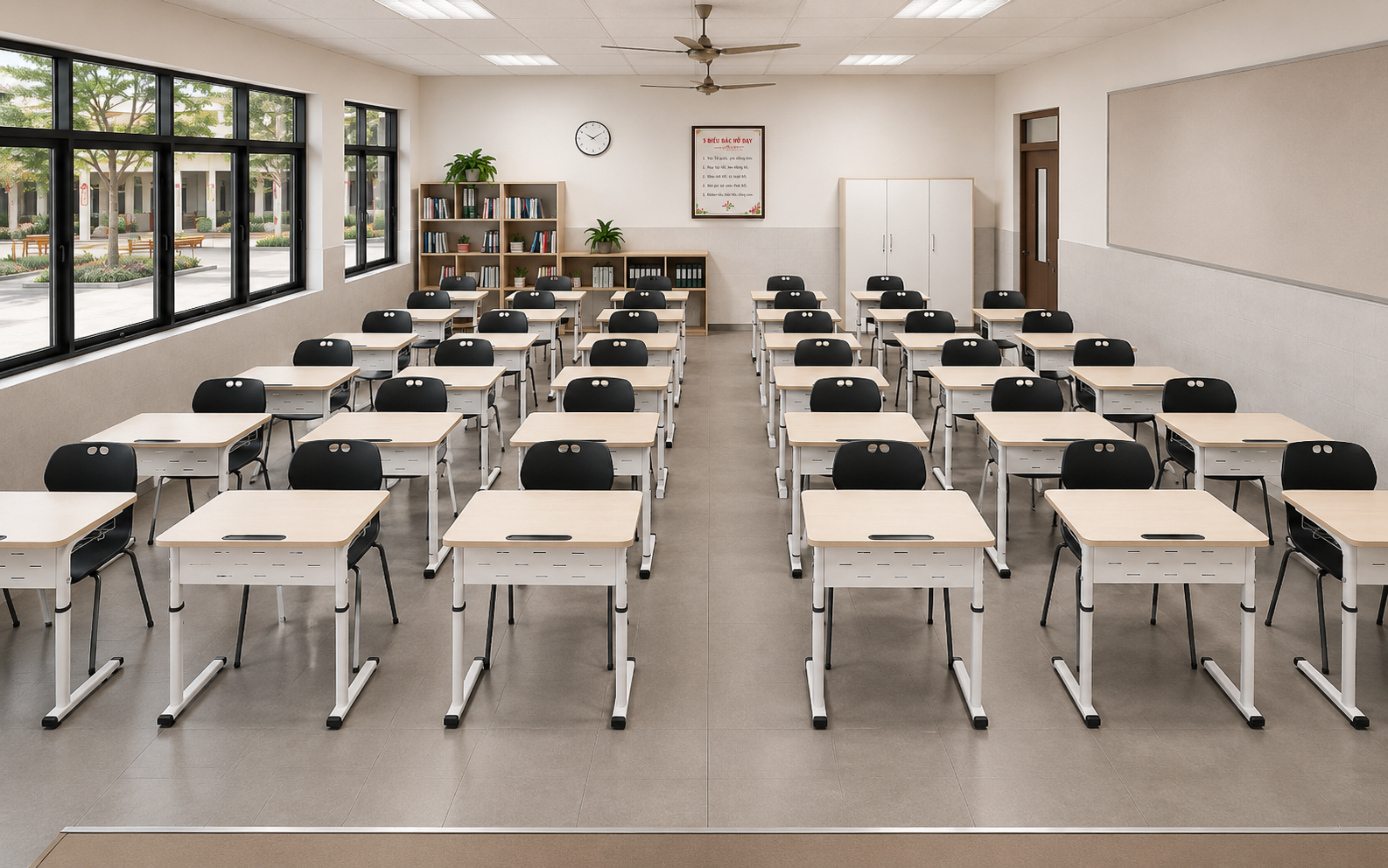
Conclusion
Ensuring the standard distance between student desks and chairs is a core factor determining the quality of the learning space and overall student health. A scientifically arranged distance, combined with ergonomic standard desk and chair dimensions, not only brings maximum comfort but also helps students maintain an upright sitting posture, effectively preventing spinal conditions such as scoliosis or vision decline. Moreover, when the body is relaxed and not constrained by cramped desks and chairs, students can more easily maintain concentration, thereby improving knowledge absorption efficiency throughout long study periods.
Recognizing this importance, parents, schools, and educational management units need to pay special attention to evaluating and choosing desk and chair products suitable for each stage of students' physical development. Boldly investing in smart desk and chair lines with height adjustability, or flexible design models for modern classroom spaces, not only meets medical standards well but also demonstrates a long-term vision in nurturing and protecting the future generation.
If schools and parents are looking for high-quality educational furniture solutions, RPB Education & Public is proud to be a reliable partner. Contact our expert consulting team today to receive product price quotes most suitable for each specific school project. Additionally, customers can view the student desk and chair catalogue on the RPB Education & Public website to explore modern, durable, and space-optimizing design models.
Related News
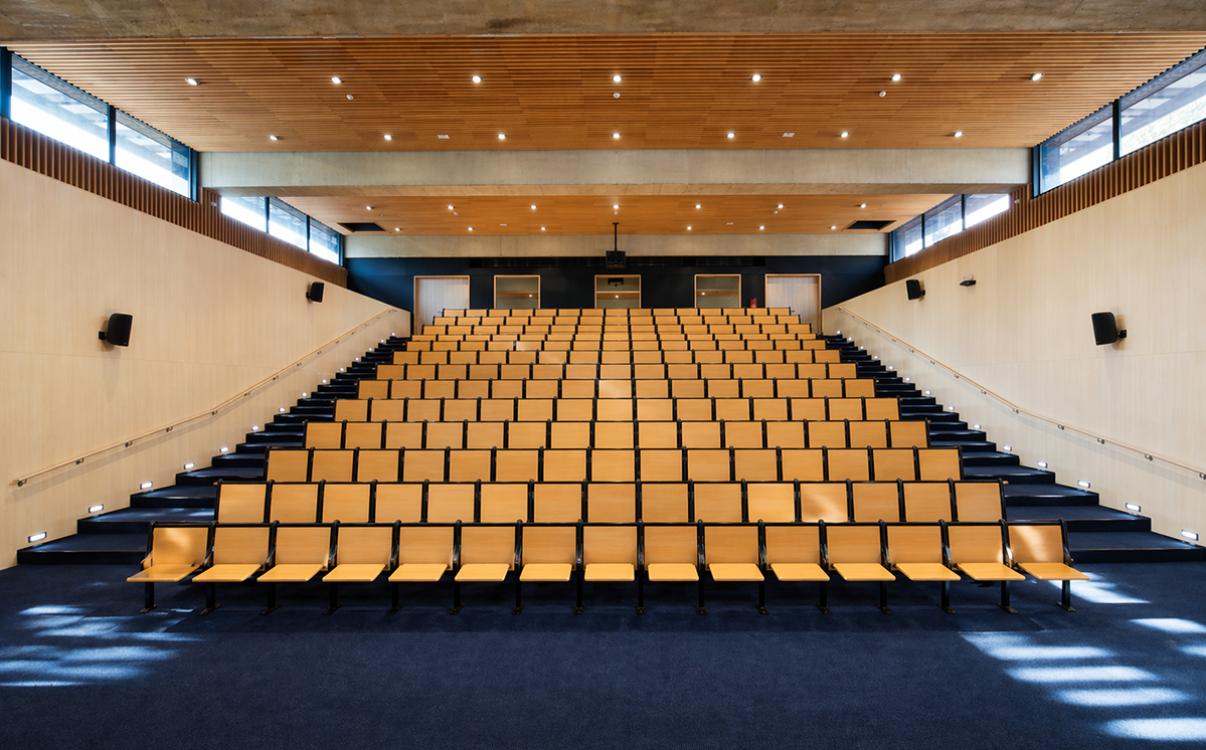
Bench Desk - Optimizing Lecture Hall and Classroom Space
Explore bench desks for lecture halls, classrooms, and training centers. Learn about their structure, advantages, how to choose, and outstanding models at RPB Education & Public right below.

Kích thước ghế băng chờ inox, nhựa, nệm: Bảng thông số chi tiết nhất
Cập nhật bảng kích thước ghế băng chờ inox, nhựa, nệm theo 2–5 chỗ ngồi; kèm cách bố trí lối đi, chọn thông số phù hợp từng không gian như bệnh viện, trường học, văn phòng, bến xe.

What is a Stool? Classification, Uses and Standard Sizes
Learn what a stool is, popular types of stools, practical uses, standard sizes, and how to choose the right stool for your home, school, restaurant, and office.

Office Relocation Announcement – Elevating Your Experience
To enhance service quality, expand our workspace, and provide a better experience for our customers, we are pleased to announce the relocation of our office to a new address.

Announcement of product price adjustment
RPB Education & Public sincerely thanks our valued customers for your continued trust and partnership over the past years.
Smart Interior Design Solutions for Universities: Within a 300 Million VND Budget
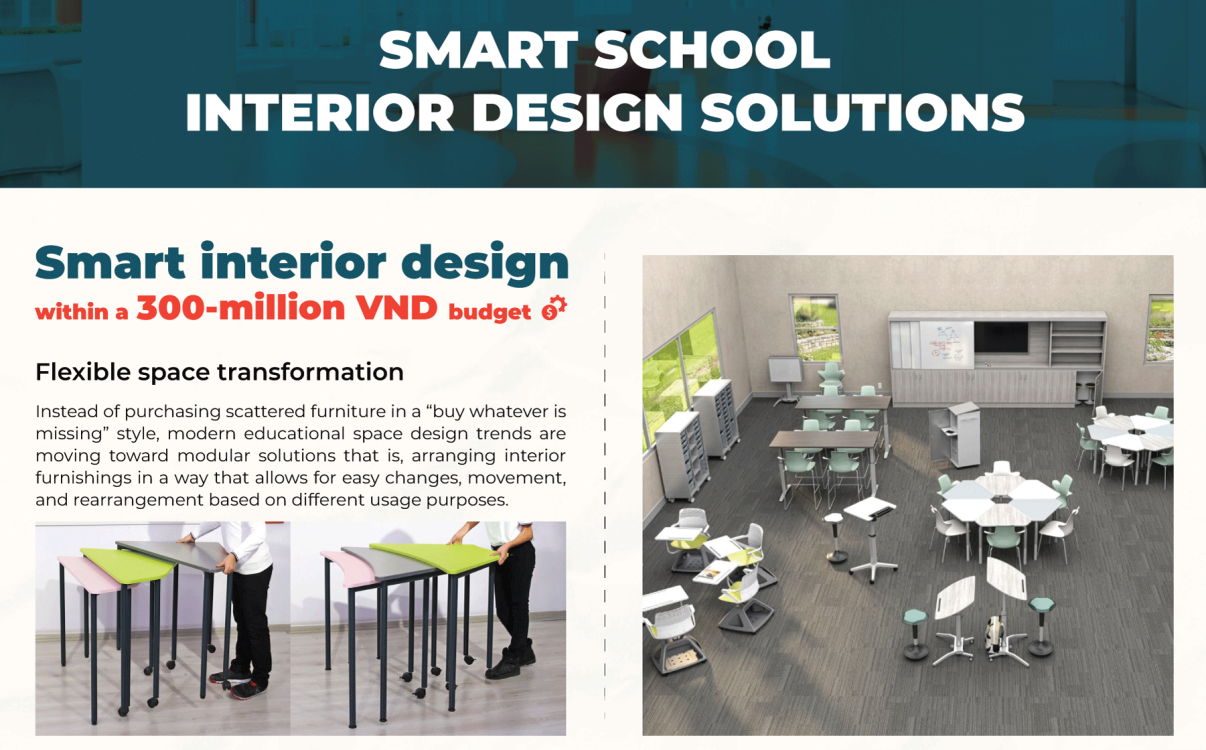
Smart university interior design within a 300-million budget is not only a financial challenge but also a strategy to elevate the learning experience. With the right investment, it helps create modern, inspiring, and flexible spaces aligned with new teaching methods while optimizing long-term operating costs.

Environmental permit announcement
RPB Education & Public officially announces its environmental permit in accordance with current regulations, reaffirming the company's commitment to legal compliance, environmental protection, and sustainable development. This is an important step to ensure that all of RPB’s business and production activities are aligned with the goal of being environmentally friendly, safe for the community, and contributing to a greener future for the next generation.